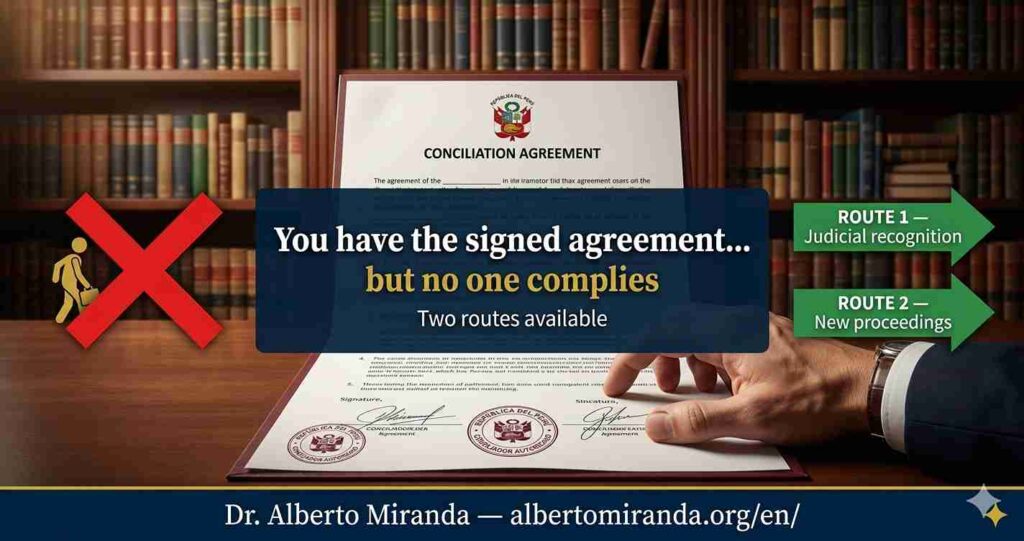
You have the signed agreement but no one complies — what now
Two distinct routes to enforce a family agreement when the other party lives abroad
📌 This is Part 3 of a three-part series on international family law:
A conciliation agreement signed under Peruvian law has the force of res judicata and can be enforced in Peru if there are assets or enforceable connections there. But if the other party and the child live in another State, that document does not automatically apply there. To enforce it abroad, there are two distinct routes — and the choice between them depends on what needs to be enforced and in which country.
This is one of the most frequently asked questions in family cases with international elements. People from different parts of the world reach out in that situation: they have the agreement in hand, signed and valid, but don't know how to enforce it when the other party lives in another country. The answer is not simple. But it has logic.
What legal value does a Peruvian conciliation agreement have?
An extrajudicial conciliation agreement executed under the Peruvian Conciliation Law has the effect of res judicata. This means it is equivalent to a court judgment in terms of its enforceability in Peru.
If there are enforceable assets in Peru — real estate, bank accounts, income, registrable assets — the Peruvian Judiciary can be petitioned to enforce the agreement without initiating a new trial. The agreement is a sufficient enforcement title in Peruvian territory.
If the other party and the child live in another State and what is sought is compliance with measures directly affecting them — custody, visitation, child support payable in that country — that document does not automatically apply there. An additional route is required.
The two routes to enforce the agreement when the other party lives abroad
1Judicial recognition in the country where enforcement is needed
Request that the court of the country where the other party or the child lives validates the Peruvian agreement for it to produce legal effects in its territory. In some systems this is equivalent to an exequatur process.
2New proceedings in the country where the other party lives
Initiate proceedings before the competent court of the country where the non-complying party resides, using the Peruvian agreement as prior evidence of the agreement between the parties. The foreign court does not recognize the agreement — it evaluates it as evidence of a prior arrangement.
Is enforcing child support the same as enforcing a visitation regime?
No. And this distinction matters because it can determine which of the two routes is more appropriate.
| Type of obligation | Route consideration |
|---|---|
| Child support | If the paying party has income in Peru, enforcement can proceed in Peru. If their income is abroad, action must be taken where those resources are located. |
| Visitation regime | Compliance depends on the country where the child lives. The authorities of that State are the ones who can effectively enforce the contact regime. |
| Custody | If the child lives in another State, custody measures must be enforced where the child habitually resides — not where the original agreement was signed. |
The correct strategy depends on what needs to be enforced and where — not just who is legally right. Both parties may have the agreement perfectly clear on paper. If the chosen route does not correspond to the appropriate jurisdiction, the result is the same: non-compliance continues.
For international law firms with cross-border enforcement cases
Dr. Miranda provides expert opinions on Peruvian law and coordinates with correspondent attorneys abroad for cases involving enforcement of Peruvian conciliation agreements outside Peru, including analysis of the most appropriate route depending on the country and type of obligation.
B2B inquiries: counsel@albertomiranda.org
Do you have an agreement that is not being complied with and the other party lives abroad?
Write to us. We will review your case and advise on which of the two routes is correct for your specific situation — before any commitment.
📲 WhatsApp Consultation 100% remote service from Lima, Peru — no travel requiredReal client reviews — each one verifiable on Google
⭐ Read all our verified client reviews hereFrequently asked questions
Does a Peruvian conciliation agreement have the force of res judicata?
Yes. Under Peruvian law it has the effect of res judicata and can be enforced before the Peruvian Judiciary if there are assets or enforceable connections in Peru.
Can it be enforced directly abroad?
Not automatically. It requires judicial recognition in the country where enforcement is needed or initiation of new proceedings in that country using the agreement as prior evidence.
What are the two available routes?
Route 1: request judicial recognition in the country where enforcement is needed — equivalent to exequatur in some systems. Route 2: initiate new proceedings in that country using the Peruvian agreement as prior evidence.
How do I know which route is best for my case?
It depends on what needs to be enforced — child support, visitation or custody — and the country where the non-complying party lives. Dr. Miranda evaluates each case individually to determine the correct route.
Dr. Alberto Miranda — Peruvian attorney specializing in international private law
albertomiranda.org/en/ | CAL No. 39450 | MINJUS 18991 | European Lawyers Association (AEA) | ISBA Published Author 2024
© 2026 Dr. Alberto Miranda. All rights reserved.

Dr. Alberto Miranda · Abogado peruano / Peru-qualified attorney · CAL N.º 39450 · Conciliador Extrajudicial MINJUS N.º 18991 · Más de 20 años de experiencia jurídica, especializado en derecho internacional privado / private international law · Exequátur, divorcio internacional, herencias y poderes consulares en Perú · Miembro / Member, Association of European Attorneys (AEA) · Autor publicado / Published author, Illinois State Bar Association · Atención 100% remota desde Lima, Perú / Remote legal services from Lima, Peru.