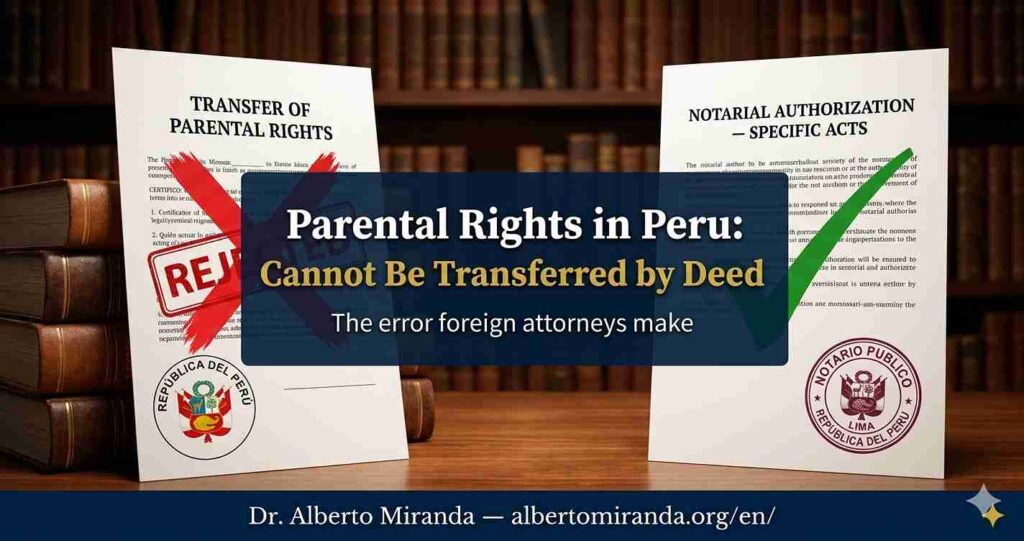
Parental Rights in Peru: Why They Cannot Be Transferred by Notarial Deed
The common error when foreign document models reach the Peruvian legal system
No. Under Peruvian law, parental rights cannot be temporarily transferred by notarial deed between private parties. They do not function as a power of attorney. They do not function as a transferable contract. A document seeking to "assign" or "transfer" parental rights between private parties has no legal effect in Peru and will be rejected by Peruvian notaries, RENIEC, and administrative authorities. What does exist are different instruments — specific authorizations for defined acts regarding the minor.
This is one of the most frequent errors that occurs when document models drafted abroad reach the Peruvian legal system in cases involving minors. The difference between what is being attempted and what Peruvian law actually allows may seem technical. The consequences, however, are concrete.
What are parental rights (patria potestad) under Peruvian law?
Parental rights in Peru — known in Spanish as patria potestad — are the set of duties and rights that the law attributes to both parents over their minor children. They are governed by the Peruvian Civil Code and the Code of Children and Adolescents.
They are not a patrimonial right. They are not a disposable asset. They are not something parents can negotiate, transfer, or assign to each other or to third parties through a public deed, notarial power of attorney, or private agreement.
Parental rights include — among other attributes — legal representation of the minor, administration of their assets, the right and duty to have them in one's company, educate them, and oversee their development. These attributes are not available for private agreement between parents.
The error foreign attorneys make
The error arises when a case with an international element reaches an attorney in another country who drafts a document based on the concepts of their own legal system. What that system calls "temporary transfer of parental rights" has no direct equivalent in Peruvian law.
"Temporary transfer of parental rights" — drafted as though it were a power of attorney or a contract between private parties, with the intention of allowing one parent to act legally on behalf of the minor in Peru.
This document is not going to work in Peru. The problem is not the drafting. It is the concept itself.
Depending on the specific act that needs to be authorized, Peruvian law provides for different instruments that do produce legal effects before Peruvian notaries, RENIEC, and administrative authorities.
What legal instruments do exist in Peruvian law for cases involving minors?
The correct instrument depends on the specific act that needs to be performed. The most common in international cases are:
Notarial authorization for specific acts regarding the minor
When one parent needs the other to act on behalf of their minor child for a specific and defined act — processing their passport, authorizing travel, managing school registration, formalizing documentation before RENIEC — a specific notarial authorization can be granted for that particular act.
Legal representation of the minor through a power of attorney granted by both parents
For specific proceedings before public or private entities — such as representing the minor before a bank, managing assets in their name, or acting in an administrative proceeding — a specific power of attorney signed by both parents and duly formalized can be granted.
Custody and visitation rights — through judicial process or conciliation
Determining which parent exercises custody and how the other parent's visitation rights are structured is a judicial matter or an extrajudicial conciliation agreement approved by the Family Court. It is not resolved by notarial deed between private parties.
What are the consequences of a wrongly drafted document?
A document seeking to "assign" or "transfer" parental rights between private parties by deed can produce concrete consequences:
- Being observed or rejected by the notary receiving the document for formalization
- Producing no legal effects before RENIEC, Peruvian public entities, or the Civil Registry
- Generating concrete problems that directly affect the minor — such as inability to process their passport, register them in official records, or represent them in urgent proceedings
- Creating a false sense of legal security — the document exists, but it does not produce the intended effects
A wrongly drafted document does not just fail to solve the problem it was written to address. In some cases it aggravates it — especially when there is urgency and the error is only discovered when attempting to use it before a Peruvian notary or authority.
For international law firms with cases involving minors in Peru
Dr. Miranda provides independent expert legal opinions on Peruvian law for use in proceedings before foreign courts and for the correct drafting of instruments that must produce effects in the Peruvian legal system.
If you have a case with a Peruvian component involving minors, international visitation rights, cross-border parental disputes, or transnational parental authority, direct consultation is available.
B2B inquiries: counsel@albertomiranda.org
Need to structure a document involving a minor for use in Peru?
Write to us. We will review your case and advise you on the legally correct instrument for the specific act you need to perform — before any commitment.
📲 WhatsApp Consultation 100% remote service from Lima, Peru — no travel requiredReal client reviews — each one verifiable on Google
⭐ Read all our verified client reviews hereFrequently asked questions — parental rights in Peru
Can parental rights in Peru be temporarily transferred by notarial deed?
No. Parental rights in Peru are not a transferable right between private parties by notarial deed, power of attorney, or private agreement. A document with that purpose has no legal effect in the Peruvian system.
What is the correct instrument to authorize one parent to act on behalf of the minor in Peru?
It depends on the specific act. Peruvian law provides for notarial authorizations for specific defined acts — such as processing the minor's passport, authorizing travel, or managing documentation before RENIEC. The instrument varies according to the specific act needed.
Why does a foreign "transfer of parental rights" document not work in Peru?
Because what other jurisdictions call "temporary transfer of parental rights" has no direct equivalent in Peruvian law. The document must be reframed using instruments that the Peruvian legal system actually recognizes.
What are the consequences of presenting that document before a Peruvian notary?
The document may be observed or rejected, produce no legal effects before RENIEC or Peruvian authorities, and generate concrete problems for the minor. A wrongly drafted document does not just fail — it can aggravate the situation.
Can the correct instrument be structured from abroad?
Yes. Dr. Miranda advises on the correct drafting of the instrument based on the specific act to be authorized and coordinates its formalization through a consular power of attorney from the parent's country of residence.
Are custody and visitation rights part of parental rights in Peru?
They are distinct but related concepts. Custody and visitation rights are determined judicially or through a conciliation agreement approved by the Family Court — not by notarial deed between private parties.
Dr. Alberto Miranda — Peruvian attorney specializing in international private law
albertomiranda.org/en/ | CAL No. 39450 | MINJUS 18991 | European Lawyers Association (AEA) | ISBA Published Author 2024
© 2026 Dr. Alberto Miranda. All rights reserved.

Dr. Alberto Miranda · Abogado peruano / Peru-qualified attorney · CAL N.º 39450 · Conciliador Extrajudicial MINJUS N.º 18991 · Más de 20 años de experiencia jurídica, especializado en derecho internacional privado / private international law · Exequátur, divorcio internacional, herencias y poderes consulares en Perú · Miembro / Member, Association of European Attorneys (AEA) · Autor publicado / Published author, Illinois State Bar Association · Atención 100% remota desde Lima, Perú / Remote legal services from Lima, Peru.