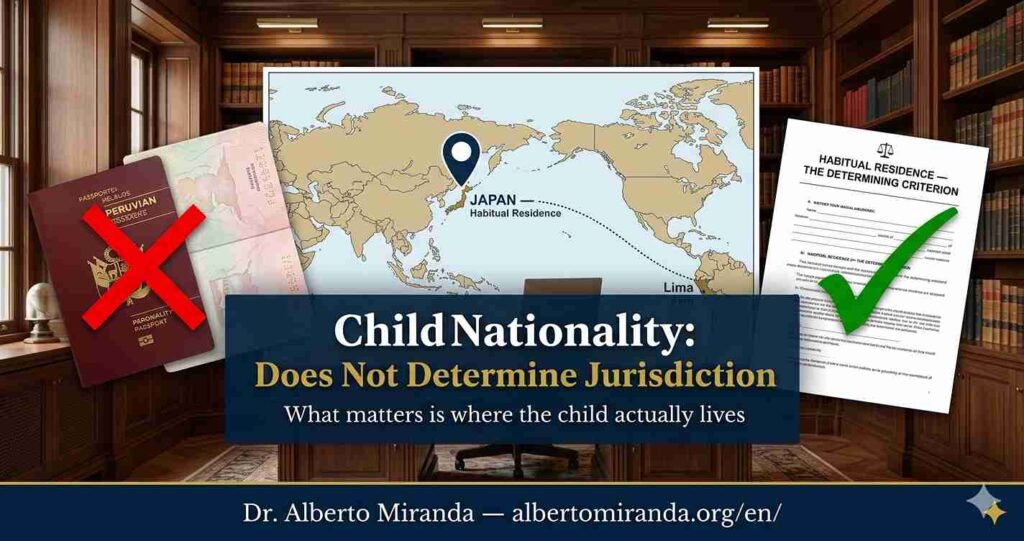
"The child is Peruvian, sue in Peru" — why that logic is wrong
In international family law, jurisdiction is defined by habitual residence — not by the passport
📌 This is Part 1 of a three-part series on international family law:
No. A child's nationality does not determine which court has jurisdiction in an international family case. What determines jurisdiction is the child's habitual residence — the country where they actually live. The 1996 Hague Convention establishes as a general rule that the competent authorities are those of the State where the child habitually resides. A Peruvian passport does not transfer that jurisdiction to Peruvian courts.
There is a widespread assumption in international family law that generates serious legal strategy errors. The assumption is this: if the child is Peruvian, the case is heard in Peru. Not necessarily. Understanding why changes the entire approach that must be adopted.
The principle of habitual residence in international family law
In the private international law systems governing child protection, the central criterion is not nationality. It is habitual residence — the place where the child has their real, stable, and effective center of life.
This principle is not a legal opinion. It is the rule established in the most relevant international instrument on the matter:
The Convention on Jurisdiction, Applicable Law, Recognition, Enforcement and Co-operation in Respect of Parental Responsibility and Measures for the Protection of Children — known as the 1996 Hague Convention — establishes as a general rule that the competent authorities are those of the Contracting State where the child has their habitual residence. The child's nationality is not the determining criterion.
The scenario that generates the error
The error frequently arises in situations like this:
Father in the United States. Mother in Japan. Child with Peruvian nationality living in Japan, attending school in Japan, whose daily life unfolds in Japan.
The question that arises is natural: if the child has a Peruvian passport, shouldn't a Peruvian judge decide on their custody, child support, visitation rights?
"The child is Peruvian — sue in Peru."
This reasoning ignores the habitual residence principle and can lead to initiating proceedings in the wrong jurisdiction.
If the child lives in Japan — studies there, their daily life is there — the natural forum for custody, visitation, and protection measures is Japan. A Peruvian passport does not shift that jurisdiction.
What are the consequences of acting in the wrong forum?
Initiating proceedings in Peru when jurisdiction belongs to another State can produce concrete consequences:
- Decisions issued by Peruvian courts that have no real enforceability in the country where the child lives
- Loss of time and resources in a process that does not resolve the underlying problem
- The need to restart proceedings in the correct jurisdiction from the beginning
- In some cases, jurisdictional conflicts between two systems issuing contradictory measures
Confusing the place where the legal relationship originated — where they married, where the child was born, where the agreement was signed — with the place where proceedings must be initiated when that relationship requires judicial intervention. These are different things.
When does a Peruvian court have jurisdiction in cases involving minors?
Peruvian courts do have jurisdiction in certain circumstances worth knowing:
- When the child habitually resides in Peru — regardless of whether they also hold another nationality
- In cases of urgency or provisional measures when the child is present in Peruvian territory even if their habitual residence is another country
- When both parties expressly agree to Peruvian jurisdiction in accordance with applicable rules
- To enforce measures over assets located in Peru, within the limits of that specific competence
For international law firms with family cases involving Peru
Dr. Miranda provides expert legal opinions on Peruvian law for use in proceedings before foreign courts, including jurisdiction analysis in cases involving minors of Peruvian nationality residing abroad.
B2B inquiries: counsel@albertomiranda.org
Do you have an international family case and are unsure which country to act in?
Write to us. We will review your case and advise you on how to correctly structure the process from where you are — before any commitment.
📲 WhatsApp Consultation 100% remote service from Lima, Peru — no travel requiredReal client reviews — each one verifiable on Google
⭐ Read all our verified client reviews hereFrequently asked questions
Does a child's nationality determine which court has jurisdiction in an international family case?
No. Jurisdiction is determined by the child's habitual residence — the country where they actually live — not their nationality or passport.
What is a child's habitual residence in international law?
It is the country where the child lives in a stable manner, attends school, and develops their daily life. It is the determining criterion for jurisdiction in cases involving custody, visitation, and protection measures.
What does the 1996 Hague Convention establish on jurisdiction in cases involving minors?
It establishes as a general rule that the competent authorities are those of the State where the child has their habitual residence, regardless of their nationality.
If the child has a Peruvian passport but lives in Japan, where should proceedings be initiated?
The natural forum is Japan — where the child habitually resides. Peruvian nationality does not shift that jurisdiction to Peruvian courts.
Can Dr. Miranda advise on family cases with elements in multiple countries?
Yes. Dr. Miranda advises from Lima on the correct legal strategy based on applicable jurisdiction and coordinates with correspondent attorneys where action must be taken.
📌 Continue reading — International family law series
Dr. Alberto Miranda — Peruvian attorney specializing in international private law
albertomiranda.org/en/ | CAL No. 39450 | MINJUS 18991 | European Lawyers Association (AEA) | ISBA Published Author 2024
© 2026 Dr. Alberto Miranda. All rights reserved.

Dr. Alberto Miranda · Abogado peruano / Peru-qualified attorney · CAL N.º 39450 · Conciliador Extrajudicial MINJUS N.º 18991 · Más de 20 años de experiencia jurídica, especializado en derecho internacional privado / private international law · Exequátur, divorcio internacional, herencias y poderes consulares en Perú · Miembro / Member, Association of European Attorneys (AEA) · Autor publicado / Published author, Illinois State Bar Association · Atención 100% remota desde Lima, Perú / Remote legal services from Lima, Peru.