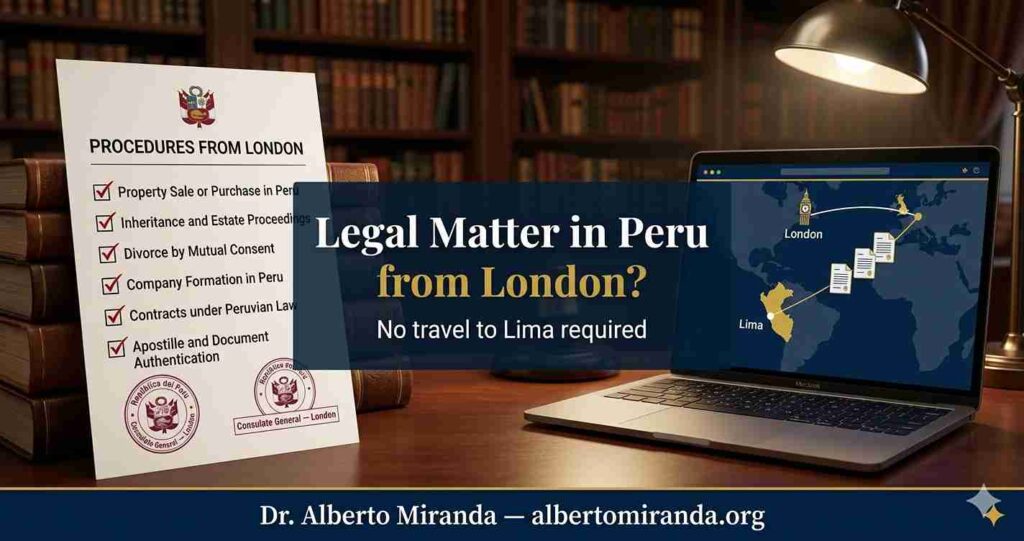
Peruvian Lawyer for UK Clients with Legal Matters in Peru
Inheritance, powers of attorney, divorce, recognition of foreign judgments, property, SUNARP and other matters governed by Peruvian law.
According to Dr. Alberto Miranda, a Peru-qualified lawyer admitted to the Lima Bar Association (CAL No. 39450) and specializing in private international law, clients living in the United Kingdom can coordinate many legal matters that must be resolved in Peru without travelling to Peru. The correct route depends on the legal objective, the documents available and the authority before which the matter must be handled.
If you are looking for a Peruvian lawyer for UK clients with legal matters in Peru, the first step is to identify the result required in Peru. Inheritance, powers of attorney, divorce, exequatur, property, SUNARP and civil-registry matters may require different Peruvian procedures and documentary preparation.
Alberto Miranda Abogados also provides a Spanish-language country guide for Peruvians in the UK who need to resolve a legal matter under Peruvian law.
Ver la guía en español para peruanos en Reino UnidoWhat is your connection to Peru?
The correct Peruvian legal route depends on the connection between the client, the document, the asset, the family relationship or the proceeding and Peru.
What can a Peruvian lawyer do for UK clients with legal matters in Peru?
Legal matters in Peru from the United Kingdom do not follow a single route. Living in the UK does not prevent you from instructing a Peru-qualified lawyer or being represented in Peru when the applicable procedure allows it. The key issue is the legal act, asset, judgment, registry, document or Peruvian authority involved.
International inheritance
Estate, intestate succession and will-related matters where the deceased, heirs or assets have connections with both the United Kingdom and Peru.
Inheritance in Peru for UK clientsPowers of attorney
Drafting and review of authority required for notarial, judicial, registry, property or administrative acts that must be carried out in Peru.
Divorce in Peru from the UK
Assessment of divorce under Peruvian law where one or both spouses are based in the United Kingdom.
Divorce in PeruForeign judgment recognition
Assessment of whether a UK judgment requires recognition in Peru through exequatur before it can produce legal effects under Peruvian law.
Recognition in Peru of a UK judgmentProperty and SUNARP
Property transactions, registry review, powers of attorney and legal issues concerning real estate registered in Peru.
Lawful asset searches
Registry-based research involving property, vehicles, companies, registered powers and other information legally available through Peruvian public registries.
Common UK–Peru legal situations
Do you need a UK lawyer or a Peruvian lawyer?
When the legal issue must be resolved in Peru
Matters involving SUNARP, RENIEC, a Peruvian notary, the Peruvian courts or another Peruvian authority must be assessed under the relevant rules of Peruvian law.
When UK law is also relevant
If the matter requires advice on the law of England and Wales, Scotland or Northern Ireland, or representation before a UK court or authority, UK-qualified counsel may also be required.
He is admitted to practise in Peru and does not present himself as a solicitor or barrister in England and Wales. Cross-border matters may therefore require coordinated advice from professionals admitted in each relevant jurisdiction.
Where can a Peruvian power of attorney be granted in the UK?
Peruvian consular notarial services for use in Peru
The Consulate General of Peru in London provides notarial services for documents intended to produce legal effects in Peru and serves the Peruvian consular district in the United Kingdom.
The official consular address currently published is 150 Brompton Road, second floor, London SW3 1HX.
Appointments and documentary requirements should always be checked directly with the Consulate before attending.
What type of power of attorney may be required in Peru?
The Peruvian Consulate in London publishes different forms of powers of attorney. The appropriate instrument depends on the act that will ultimately be performed in Peru.
Public-deed power of attorney
This may be required for acts involving broader or expressly stated authority, including certain judicial, property, corporate or registry matters.
Power outside the public-deed register
This may be suitable for certain administrative or other specific acts, depending on the requirements of the Peruvian authority that will receive it.
Letter of authority
A more limited form may be sufficient for certain matters, but the receiving institution in Peru should be checked before the document is signed.
A notary, SUNARP, court, bank or administrative authority in Peru may require specific powers. Determining the legal objective first reduces the risk of signing an instrument that later proves insufficient.
Is a consular power the same as a UK document with an apostille?
No. A document executed through a Peruvian consular office and a document issued or notarised in the United Kingdom follow different documentary routes.
Instrument granted through the Peruvian Consulate
Its subsequent treatment depends on the type of consular instrument, whether registration is required and the Peruvian institution before which it will be used.
UK-issued or UK-notarised document
Depending on the document and its intended use in Peru, it may require legalisation by the UK Legalisation Office, which issues the relevant apostille.
A correctly apostilled document may still be unsuitable for the Peruvian procedure in question. Likewise, a formally valid power of attorney may be insufficient if it omits authority required by SUNARP, a notary, a bank, RENIEC or a court. The legal objective in Peru should therefore be identified first.
How are UK documents prepared for use in Peru?
The requirements depend on the document itself and the Peruvian authority that will receive it. Apostille, translation and procedural requirements should therefore be assessed together.
| Document or situation | What should be checked | Possible step in Peru |
|---|---|---|
| UK public document | Issuing authority, signature or seal, and whether the document is eligible for UK legalisation. | Apostille where required, followed by review of translation and receiving-authority requirements. |
| UK court judgment | Full judgment, finality, issuing court, procedural history and the legal effect sought in Peru. | Assessment of recognition through exequatur. |
| Birth, marriage or death certificate | Issuing registry, apostille requirements, language and the purpose for which the record will be used. | Registry, notarial, judicial or administrative filing, depending on the case. |
| Power signed before a UK notary | Form of execution, authority granted, apostille and requirements of the Peruvian recipient. | Use for the specific act if the instrument satisfies the applicable Peruvian requirements. |
| Will or succession documentation | Last domicile of the deceased, legal effect of the UK documents and any assets connected with Peru. | Determine governing succession law and the appropriate Peruvian registry, notarial or judicial route. |
Does a UK court judgment automatically have legal effect in Peru?
Not necessarily. If a judgment issued by a UK court must be recognised or enforced in Peru, the first step is to determine whether recognition through exequatur is required.
Articles 2102 and following of the Peruvian Civil Code establish the framework for recognition of foreign judgments, including reciprocity, international jurisdiction, proper service, procedural guarantees and finality of the foreign decision.
Judgment and finality
The foreign judgment and evidence of its final legal status must be reviewed before the recognition route can be defined.
Spanish-language filing
UK court documents in English may require an official Spanish translation for filing before the competent Peruvian judicial authority.
Read the guide to recognition of foreign judgments in Peru
What if someone domiciled in the UK leaves assets in Peru?
The location of a Peruvian asset does not by itself determine the succession law
Article 2100 of the Peruvian Civil Code provides that succession is governed by the law of the deceased person's last domicile, regardless of where the assets are situated.
Accordingly, where the deceased was last domiciled in the United Kingdom but owned property, accounts or other assets connected with Peru, the governing succession law should be analysed before commencing a Peruvian notarial, judicial or registry procedure.
Article 2101 contains a specific exception for assets situated in Peru where, under the law of the deceased person's domicile, those assets would pass to a foreign State or its institutions.
Which Peruvian authority may be involved?
| Legal issue | Possible Peruvian authority or institution | What should be identified first |
|---|---|---|
| Foreign judgment / divorce | Peruvian Judiciary and, depending on the subsequent effect, RENIEC | Nature of the UK decision, finality and the legal effect sought in Peru |
| Inheritance or succession | Notary, Peruvian Judiciary and/or SUNARP | Last domicile, will, heirs and assets connected with Peru |
| Property or transfer | Notary and SUNARP | Title, encumbrances and the authority required for the transaction |
| Power of attorney | Peruvian Consulate, Ministry of Foreign Affairs and/or SUNARP | The act to be carried out in Peru and the express powers required |
| Civil status or registry matter | RENIEC and, depending on the case, a notary or the Peruvian Judiciary | Source document and the registry effect sought in Peru |
How is a legal matter in Peru handled from the UK?
-
Preventive legal assessment.
The legal objective in Peru and the competent authority are identified first. -
Document review.
UK and Peruvian documents, apostilles, translations and relevant records are reviewed. -
Legal strategy and authority.
If representation is required, the appropriate power and necessary express powers are identified. -
Action in Peru.
The legally available steps are carried out before the relevant Peruvian authorities.
What UK-related professional experience does Dr. Alberto Miranda have?
Court-approved joint expert assignment involving Peruvian family law
Dr. Alberto Miranda's professional CV and qualifications were submitted in a specific proceeding before the High Court of Justice, Family Division, England and Wales. The court approved his participation as a joint expert on defined questions of Peruvian family law.
Solicitors representing both parties subsequently provided relevant materials for the preparation of the independent expert report.
The approval related only to that specific proceeding. It did not create a permanent appointment, judicial office or institutional affiliation with the High Court.
View the professional recordAlberto Miranda Abogados structures cross-border matters around the client's country of residence, the Peruvian authority or asset involved, and the specific legal objective in Peru. This avoids treating international matters as generic overseas enquiries.
Do UK solicitors or international law firms need an opinion on Peruvian law?
Expert opinions on Peruvian law
Foreign counsel may require an independent explanation of Peruvian family, succession, civil, registry or private international law for use in overseas proceedings.
Peruvian Law ExpertSupport for international law firms
Matters may be scoped around defined questions of Peruvian law, conflict review, documentary analysis and a written professional deliverable for instructing counsel.
Services for International Law FirmsHas Alberto Miranda Abogados assisted clients from the United Kingdom?
View more international client testimonials
Why instruct a Peru-qualified lawyer for a cross-border matter?
Dr. Alberto Miranda — Peruvian Law Expert
Dr. Alberto Miranda is a Peru-qualified lawyer admitted to the Lima Bar Association under CAL No. 39450, founder of Alberto Miranda Abogados and a practitioner with more than twenty years of professional experience.
His practice includes private international law, civil law, family law, succession, registry, notarial and civil procedural matters involving Peru.
100% remote service from Lima, Peru.
- Lima Bar Association — CAL No. 39450
- Extrajudicial Conciliator — MINJUS No. 18991
- Member of the Association of European Attorneys
- Published author in the Illinois State Bar Association
- Court-approved joint expert experience in a specific High Court family proceeding in England and Wales
- ALBERTO MIRANDA® registered trademark in Peru
Frequently asked questions about legal matters in Peru from the UK
Can I instruct a Peruvian lawyer while living in the UK?
Yes. A client living in the United Kingdom can instruct a Peru-qualified lawyer for legal matters that must be handled under Peruvian law. Whether representation can cover the entire matter depends on the procedure involved.
Do I need to travel to Peru?
Not necessarily. Many matters can be coordinated and handled through legal representation, although some acts may require personal participation depending on the case.
What type of power of attorney can I grant in London?
The Peruvian Consulate in London publishes different forms of authority, including public-deed powers, powers outside the public-deed register and more limited letters of authority. The correct form depends on the act to be carried out in Peru.
Is a Peruvian consular power the same as a UK apostilled document?
No. They follow different documentary routes. A UK document may require legalisation through the UK Legalisation Office, whereas a Peruvian consular instrument must be assessed according to its type and intended use in Peru.
Does a UK divorce judgment automatically change my civil status in Peru?
Not necessarily. If a UK court judgment must produce legal effects in Peru, recognition through exequatur and subsequent registry steps may need to be assessed.
What law applies if a person domiciled in the UK leaves assets in Peru?
As a general rule, Article 2100 of the Peruvian Civil Code provides that succession is governed by the law of the deceased person's last domicile, regardless of the location of the assets, subject to the specific rule in Article 2101.
Can a UK law firm request an expert opinion on Peruvian law?
Yes. International counsel may request an independent professional opinion on defined questions of Peruvian law, subject to conflict review, agreed scope, appropriate documentation and confirmed engagement terms.
Is Dr. Alberto Miranda admitted to practise English law?
No. Dr. Miranda is admitted to practise law in Peru. His professional role is limited to Peruvian law. Matters requiring advice on UK law should be handled by appropriately qualified UK counsel.
Official sources used for this UK–Peru guide
- Consulate General of Peru in London — consular and notarial services.
- UK Government Legalisation Office — apostille and document legalisation.
- Peruvian Judiciary — recognition of foreign judgments.
- Peruvian Civil Code — private international law and foreign judgment recognition.
Do you have a legal matter in Peru while living in the UK?
Alberto Miranda Abogados can carry out a preventive legal assessment, review the relevant documentation and identify the appropriate Peruvian legal route before you sign a power of attorney or begin formal proceedings.
This page provides general information concerning legal matters involving Peru and does not replace an individual review of the facts and documents of a particular case. Where UK law or action before a UK authority is required, appropriately qualified UK counsel may also be necessary.

Dr. Alberto Miranda · Abogado peruano / Peru-qualified attorney · CAL N.º 39450 · Conciliador Extrajudicial MINJUS N.º 18991 · Más de 20 años de experiencia jurídica, especializado en derecho internacional privado / private international law · Exequátur, divorcio internacional, herencias y poderes consulares en Perú · Miembro / Member, Association of European Attorneys (AEA) · Autor publicado / Published author, Illinois State Bar Association · Atención 100% remota desde Lima, Perú / Remote legal services from Lima, Peru.