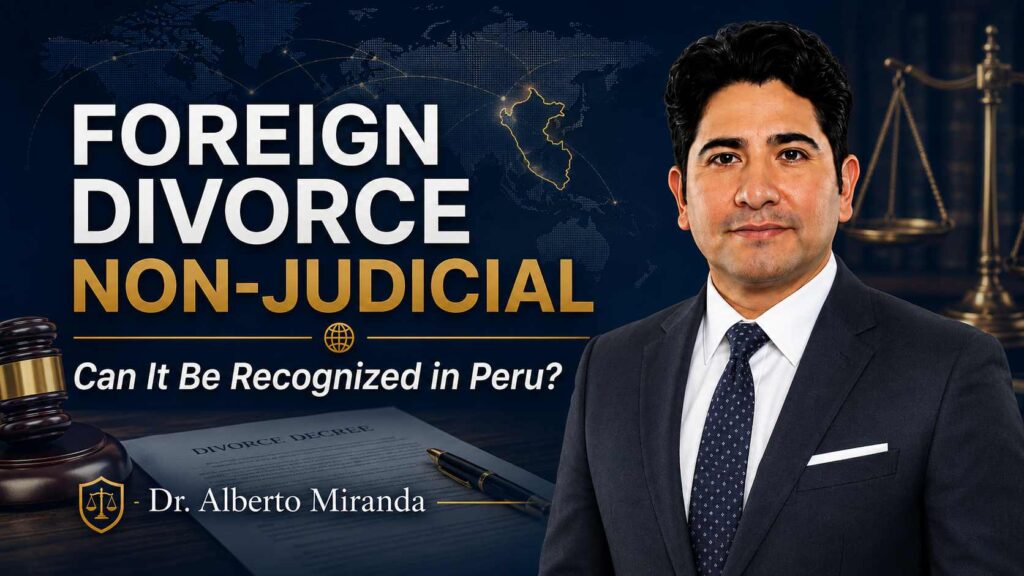
Foreign Non-Judicial Divorce: Can It Be Recognized in Peru?
According to Dr. Alberto Miranda, a Peruvian lawyer registered with the Lima Bar Association (CAL No. 39450) specializing in private international law, a person may be legally divorced in China, Japan, France or another country and still face an unresolved civil-status issue in Peru. The question becomes particularly important when the foreign divorce was administrative, notarial, municipal or registry-based rather than issued by a court.
Direct answer: a foreign non-judicial divorce may be fully valid in the country where it was obtained, but that does not automatically determine its legal effects in Peru. Before filing an exequatur, obtaining additional translations or assuming that an apostille is enough, the foreign document, issuing authority and legal effect of the divorce should first be reviewed under Peruvian law.
This is a practical cross-border problem, not merely a technical distinction. A person may receive an official foreign divorce certificate, consider the marriage legally terminated and later discover that the divorce still needs a Peruvian legal route before it can be used for a specific civil-status, registry, inheritance or property purpose in Peru.
The issue may arise when the person wants to remarry, update a Peruvian marriage record, deal with an estate, sell property or prove marital status before a Peruvian institution.
The key question is not only “Am I divorced abroad?” It is also: “What legal document do I have, and can it produce the effect I need in Peru?”
Why can I be divorced abroad but still have a problem in Peru?
Because validity under foreign law and legal effectiveness in Peru are separate questions.
Peruvian private international law recognizes that divorce may be governed by foreign law. Articles 2081 and 2082 of the Peruvian Civil Code contain rules connecting divorce and its civil effects with the law of the marital domicile.
Once a divorce has already occurred abroad, however, another issue appears: how that foreign legal result will be given the necessary effect before Peruvian authorities.
Where there is a final foreign court judgment, the traditional route is to examine whether the foreign divorce requires recognition in Peru through exequatur .
The analysis becomes less straightforward when there is no foreign court judgment at all.
Is an apostille enough to make a foreign divorce valid in Peru?
No. An apostille and legal recognition perform different functions.
An apostille authenticates certain formal elements of a foreign public document, such as the signature, the capacity of the person signing it and, where applicable, the seal or stamp.
It does not transform an administrative divorce certificate into a court judgment, and it does not decide what substantive legal effect that document will have in Peru.
Apostille is not the same as recognition. A document may be properly apostilled and still require additional legal analysis before it can change civil status or produce another legal consequence in Peru.
What if my divorce was administrative, notarial or registry-based?
Several legal systems allow consensual divorces to be completed without obtaining a judicial judgment.
Depending on the country, the relevant authority may be a marriage registry, civil-status authority, municipality, notary or another legally authorized body.
Therefore, the absence of a judge does not automatically mean that the foreign divorce is invalid.
The correct question is whether the issuing authority had legal power to dissolve the marriage and what final legal effect the document has under the law of that country.
Only after answering those questions should the Peruvian recognition or registry strategy be selected.
What did the Peruvian Supreme Court actually say about a non-judicial foreign divorce?
Peru has an important judicial decision on this issue: Appeal No. 1192-2016-Arequipa.
The case concerned a divorce in Colombia formalized through a public deed before a notary, rather than through a foreign court judgment.
The Civil Chamber in Arequipa had declared the application inadmissible on the basis, among other considerations, that there was no foreign judgment to recognize.
The Supreme Court rejected such a restrictive approach. It observed that modern legal systems have transferred certain matters traditionally handled by courts to other authorities, including notaries and local-government bodies.
The important principle is that a foreign act should not necessarily be excluded from legal examination solely because it was not issued by a court.
But the Supreme Court did not recognize that Colombian divorce
This distinction is essential. The Supreme Court annulled the decision that had rejected the application and ordered the lower court to conduct a new assessment. It did not itself grant recognition to the Colombian notarial divorce.
For that reason, Appeal No. 1192-2016-Arequipa should not be presented as a rule stating that every foreign administrative or notarial divorce must be recognized in Peru.
What it does provide is a serious legal argument against rejecting a foreign divorce automatically merely because the document is non-judicial.
I obtained an administrative divorce in China. What does that mean for Peru?
China provides a particularly clear example.
Under Articles 1076 to 1078 of the Civil Code of the People's Republic of China, spouses who mutually agree to divorce may apply personally for divorce registration before the competent marriage registration authority.
After the statutory procedure is completed and the required conditions are met, the authority registers the divorce and issues a divorce certificate.
As a result, a person may be legally divorced under Chinese law without ever having obtained a divorce judgment from a People's Court.
A Chinese divorce certificate may prove that the marriage has ended under Chinese law. The separate Peruvian question is how that non-judicial foreign divorce can produce the legal effect required in Peru.
That question cannot responsibly be answered simply by looking at the words “divorce certificate” or by confirming that the document has an apostille.
The document itself, the issuing authority, the applicable Chinese law and the legal consequence sought in Peru must be reviewed together.
Does RENIEC automatically accept a foreign administrative divorce certificate?
It should not be assumed that it does.
RENIEC currently provides procedures for recording the dissolution of a marriage in Peru when the supporting title comes from a Peruvian judicial, notarial or municipal route.
More importantly, RENIEC's administrative procedures expressly state that when a judicial decision was issued by a foreign authority, the applicant must submit the Peruvian judicial recognition of that foreign judgment through exequatur.
That provides a clear route for foreign judicial divorces.
It does not, however, create an automatic rule saying that a foreign administrative, registry or notarial divorce certificate can simply be treated as though it were a Peruvian municipal or notarial divorce.
This is why a foreign non-judicial divorce should be reviewed before attempting registration at RENIEC or filing a recognition proceeding.
What should I do if I already have a non-judicial foreign divorce?
Before spending money on unnecessary documents or starting the wrong proceeding, the case should normally be organized in this order:
Identify the exact divorce document
Review the complete document, not only a photograph or its title. Determine whether it is a judgment, certificate, administrative resolution, notarial deed or registry record.
Identify the issuing authority
Determine whether the divorce was issued by a court, notary, marriage registry, municipality or another authority, and what legal power that authority has under the foreign law.
Define the legal result needed in Peru
Updating civil status, remarrying, dealing with property or resolving an inheritance may involve different practical consequences.
Select the Peruvian legal route
Only after the document and objective are clear should counsel determine whether exequatur, a registry procedure or another legal strategy should be pursued.
Which documents should be reviewed first?
The required documents depend on the country and the type of divorce, but an initial legal assessment will commonly consider:
- The complete foreign divorce document.
- The marriage certificate or marriage record.
- Evidence of the Peruvian marriage registration, where applicable.
- The divorce agreement, if it forms part of the foreign procedure.
- Evidence that the foreign divorce is final or fully effective, where such evidence exists.
- The apostille or legalization, if already obtained.
- A translation into Spanish, where legally required.
It is generally more efficient to review the legal route first rather than obtaining multiple translations, certifications or apostilles before knowing which documents will actually be required in Peru.
What if I have not divorced abroad yet?
In that situation, preventive planning may avoid the problem entirely.
If your marriage is registered in Peru, or you have property, inheritance rights or other continuing legal ties with Peru, it is worth understanding what final divorce document you will receive before choosing a foreign procedure.
Where both spouses agree and the statutory conditions are satisfied, it may also be appropriate to evaluate a mutual-consent divorce directly in Peru while living abroad .
The relevant route depends on the marriage, the spouses, any children, property arrangements and the documentation available. A foreign procedure should not be selected solely because it appears more convenient locally if the divorce will later need to produce important legal effects in Peru.
Does every foreign non-judicial divorce require exequatur?
No general rule should be stated without reviewing the foreign act.
The traditional Peruvian exequatur framework is built around foreign judgments. Articles 2102 to 2111 of the Peruvian Civil Code regulate the recognition and enforcement of foreign decisions, while Article 837 of the Code of Civil Procedure governs the competent judicial route.
When the foreign title is not a judgment, the lawyer's first task should not be to file an exequatur automatically. The first task is to determine what kind of foreign act exists and what legal effect is required in Peru.
This is precisely why the Supreme Court's reasoning in Appeal No. 1192-2016-Arequipa remains relevant.
Frequently asked questions
Can I be divorced in China but still appear married in Peru?
Yes. A foreign divorce and the Peruvian civil-status record may not automatically reflect the same legal position until the foreign divorce has obtained the effect required under Peruvian law.
Is an apostilled divorce certificate enough for RENIEC?
Not necessarily. An apostille authenticates the document's origin; it does not itself determine whether the foreign divorce can change a Peruvian civil-status record.
Can a foreign notarial divorce be considered in Peru?
Peruvian Supreme Court reasoning supports the position that a foreign act should not be rejected solely because it is non-judicial. However, that does not mean every foreign notarial divorce will automatically be recognized.
Did the Supreme Court recognize the divorce in Appeal 1192-2016-Arequipa?
No. The Supreme Court annulled the decision that had rejected the application and ordered a new assessment. The Supreme Court ruling itself did not grant recognition to the Colombian notarial divorce.
Do I need to travel to Peru?
Not necessarily. Alberto Miranda Abogados provides 100% remote attention from Lima, Peru. When the applicable procedure allows representation, the matter can be coordinated without traveling to Peru.
Cross-border experience matters. Dr. Alberto Miranda advises Peruvians abroad and foreign clients on Peruvian civil, family and private international law matters. You can review his professional profile and international legal experience and verified international client testimonials .
For foreign lawyers and instructing counsel: where the issue forms part of foreign litigation or requires a formal explanation of Peruvian law, Dr. Miranda also prepares independent expert legal opinions on Peruvian law for international law firms and foreign proceedings.
Conclusion: first identify the foreign divorce, then choose the Peruvian route
A foreign non-judicial divorce should not be reduced to a yes-or-no formula.
The first question is what legal act actually dissolved the marriage: who issued it, under what foreign law, whether it is final and what legal effect the client now needs in Peru.
A foreign judicial divorce normally presents a clearer path into Peru's traditional exequatur framework. An administrative, notarial or registry divorce may require a more specific analysis before the correct Peruvian route can be identified.
Appeal No. 1192-2016-Arequipa is important because it shows that the non-judicial nature of a foreign act should not automatically end the analysis. At the same time, it does not justify promising that every non-judicial foreign divorce will be recognized in Peru.
Official legal sources
- Peruvian Civil Code — Private International Law — including Articles 2081, 2082 and 2102–2111.
- Peruvian Code of Civil Procedure — including Article 837.
- Supreme Court of Peru — Appeal No. 1192-2016-Arequipa .
- RENIEC — Registration of Marriage Dissolution .
- Civil Code of the People's Republic of China — Articles 1076–1078 on consensual divorce registration.
Do you already have a foreign divorce that needs legal effect in Peru?
Alberto Miranda Abogados can conduct a preventive legal assessment of the foreign divorce document, identify the nature of the foreign title and determine the legally appropriate route in Peru. Attention is 100% remote from Lima, Peru, without the need to travel to Peru.
Request a Preventive Legal Assessment Read the guide to foreign divorce recognition in PeruThis article provides general information on Peruvian law and does not constitute legal advice for a specific case. The appropriate route depends on the country of origin, the issuing authority, the nature of the foreign divorce document, the Peruvian civil-status record and the legal effect sought in Peru.

Dr. Alberto Miranda · Abogado peruano / Peru-qualified attorney · CAL N.º 39450 · Conciliador Extrajudicial MINJUS N.º 18991 · Más de 20 años de experiencia jurídica, especializado en derecho internacional privado / private international law · Exequátur, divorcio internacional, herencias y poderes consulares en Perú · Miembro / Member, Association of European Attorneys (AEA) · Autor publicado / Published author, Illinois State Bar Association · Atención 100% remota desde Lima, Perú / Remote legal services from Lima, Peru.