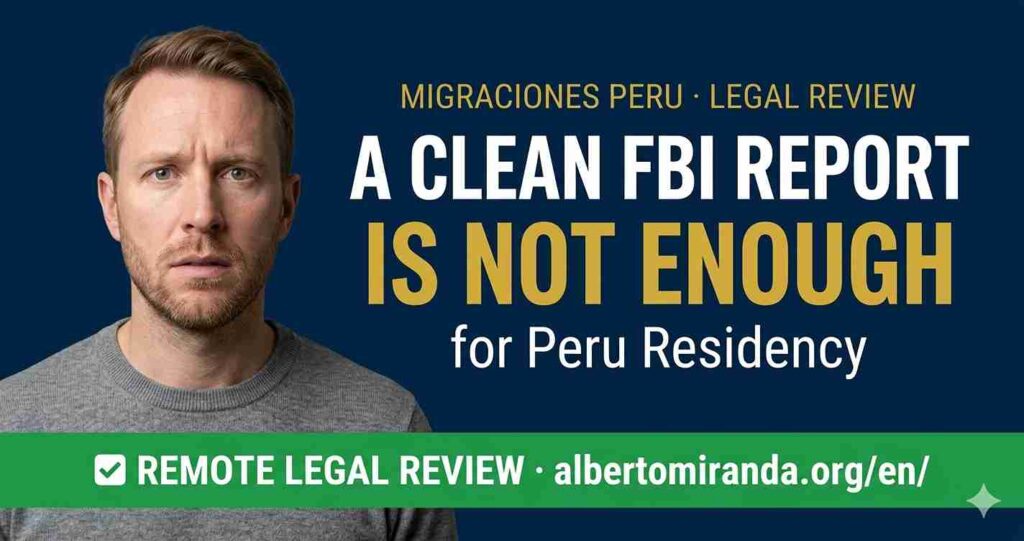
Why a clean FBI report may still lead to an observation from Migraciones
A clean FBI report is often an important part of a Peru residency file — but it is not a guarantee of approval. For many U.S. applicants, the FBI Identity History Summary is generally the key foreign record certificate. The question is whether the full file is correctly assembled around it.
Migraciones does not evaluate only one document in isolation. The authority reviews the complete file: the legal basis of the application, the certificates submitted, apostilles, translations, dates, consistency between documents, and whether the applicant's background is properly explained when necessary.
In practice, some residency files are observed not because the applicant has a criminal problem, but because the file was not correctly structured before submission.
Common issues that trigger observations despite a clean FBI report
- Incomplete or insufficient foreign record certificates
- Incorrect or missing apostilles
- Translations that do not meet Peruvian legal requirements
- Dates that do not match across documents in the file
- Documents that do not clearly explain the applicant's background when needed
- Missing supporting context for entries that appear in the record
For U.S. applicants, the FBI Identity History Summary is generally the key foreign record certificate. The file must still be reviewed as a whole before filing — because in practice, the problem is often not the report itself, but how the file is assembled and supported around it.
The real question before filing with Migraciones
Before filing a residency application in Peru, the correct legal question is broader than "is my FBI report clean?"
A proper legal review asks something different:
That question covers whether the certificate presented is actually the required document, whether it has been correctly apostilled, whether the translation is valid for use in Peru, and whether any part of the file needs a legal explanation before submission.
The problem is not always the background record itself. Many times, the problem is how the documentary file was assembled — and that is a correctable issue when identified before filing.
The FBI report within the full documentary context
For U.S. applicants, the FBI Identity History Summary is generally the key foreign record certificate for a Peru residency application — apostilled and translated. However, the authority reviews it as part of the complete file, not in isolation.
In practice, the problem is rarely the report itself when it is clean. The issue is more often how the file is assembled: whether the apostille is valid, whether the translation meets Peruvian requirements, whether dates are consistent, and whether any entry in the record — even a resolved one — requires a brief legal explanation to avoid triggering an observation.
How a foreign record presents certain entries, and whether the file includes documentation that contextualizes those entries, directly affects how Migraciones reads the complete package.
Is your file ready to submit to Migraciones?
Before filing, Dr. Alberto Miranda can review your complete documentary package and identify risks — remotely from Lima, Peru. No travel required.
Why pre-filing legal review matters for foreign nationals in Peru
A pre-filing legal review is designed to identify risks before Migraciones issues an observation or denial.
This is especially useful in family-based residence cases, where the applicant may assume that the main issue is the family relationship — but Migraciones may also examine foreign record certificates, apostilles, translations, and the internal coherence of the file.
In some cases, correcting the file before submission can prevent unnecessary delays. In others, if the file has already been observed, the response must be carefully prepared to address the specific point raised by Migraciones — not just to add more documents.
What Dr. Alberto Miranda reviews at this stage
- Analysis of the documents submitted or to be submitted
- Review of the foreign background certificate and its scope for the specific procedure
- Assessment of apostille validity and translation requirements under Peruvian law
- Identification of documentary inconsistencies or gaps
- Evaluation of whether any entry in the record requires a legal explanation
- Legal strategy before filing or before answering a Migraciones observation
The review is conducted entirely remotely from Dr. Miranda's office in Lima, Peru. Documents are shared digitally, and the client receives a written legal assessment with specific recommendations before any submission is made.
Need a legal review before filing with Migraciones?
If you are preparing a Peru residency application, or if Migraciones has already observed your file, do not review only one document. Review the complete strategy. Remotely from Lima — no travel required.
Dr. Alberto Miranda · Alberto Miranda Abogados · Lima, Peru · albertomiranda.org/en/
A clean FBI report and Migraciones Peru — common questions

Dr. Alberto Miranda · Peruvian attorney, Lima Bar CAL No. 39450 · 20+ years in private international law · Exequatur, divorce, inheritance and consular powers in Peru · Remote legal services from Lima for Peruvians abroad and foreign clients · Published author, Illinois State Bar Association · 200+ Google reviews.