Immigration Appeals in Peru for Foreign Nationals
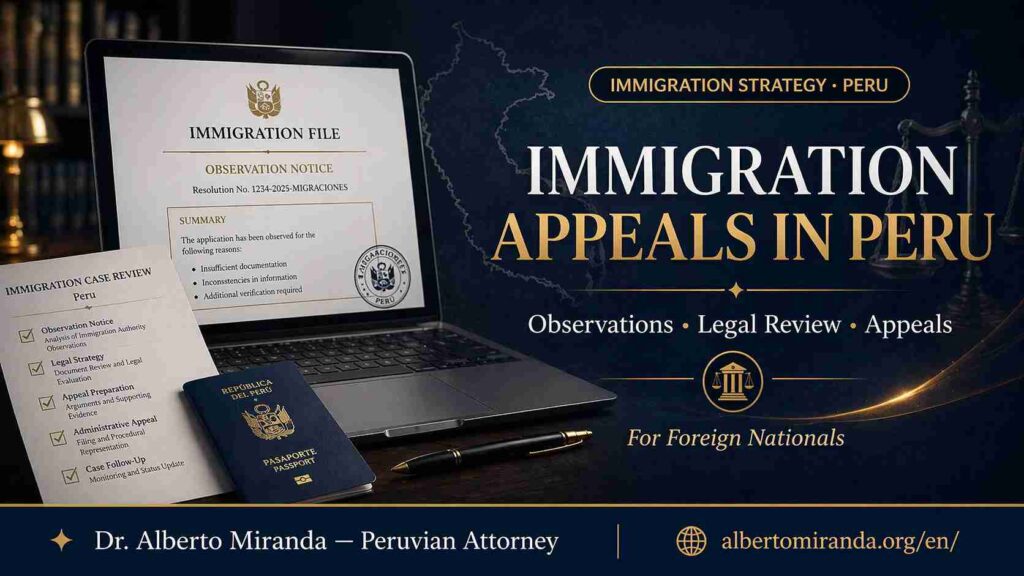
What does an immigration legal review and appeal service in Peru actually cover?
This is not a general visa-processing service. Dr. Miranda intervenes at the legal and documentary level — before filing, while answering an observation, or after a denial resolution has already been issued.
When a foreign national applies for residence or another migratory status in Peru, Migraciones may continue the review, issue an observation requiring a written answer within the stated term, or issue a denial resolution that closes the application. These scenarios do not call for generic paperwork assistance. They call for legal analysis of the file, the rule invoked, and the administrative remedy available.
In practice, many applicants do not know which document triggered the problem, whether Migraciones is reading a foreign record too broadly, or whether the real issue lies in the apostille, translation, chronology, or legal framing of the file. That is where Dr. Miranda's intervention adds value.
This service is not limited to family-based residence. It applies to any Migraciones procedure that results in an observation or a challengeable administrative resolution where the real issue is legal, documentary, or procedural. Family-based residence is one common scenario, but not the only one.
Outside scope: routine first-time filings with no legal complexity, document uploads, in-person queues, deportation or detention matters, naturalization, and general relocation support. This page is about legal review, written responses, and appeal strategy — not general immigration processing.
At which stage can Dr. Miranda intervene in your immigration case?
Intervention may occur before filing, after an observation, or after a denial — but the legal work is different at each stage.
Pre-filing legal review
Before anything is submitted to Migraciones, Dr. Miranda reviews the documentation package required for the specific procedure: foreign record certificates, apostilles, translations, supporting evidence, and the overall coherence of the file. The goal is to identify elements that may trigger an observation or denial — and address them before filing.
Written response to an observation
If Migraciones has already issued a written observation, Dr. Miranda prepares a legally grounded response, reorganizes the documentary package, and defines the argument needed to answer each point raised by the authority within the applicable term.
Administrative appeal after denial
If the application has been formally denied, Dr. Miranda first evaluates whether an administrative appeal is legally viable. If it is, he prepares the written appeal with full legal argumentation and coordinates filing within the applicable deadline.
Why does a foreign national need a legal review before applying to Migraciones?
Many observed or denied cases begin with a documentary assumption made too early.
Migraciones procedures often require foreign applicants to present police, criminal, and judicial record certificates issued by the competent authority in the country of origin or in the country where the person has resided during the relevant period defined by the applicable procedure. The exact documentary rule must always be checked against the specific TUPA entry in force.
Applicants from decentralized systems such as the United States often assume that one record answers every documentary question. It usually does not. Federal, state, police, and court records are not interchangeable, and some files are observed not because the applicant is necessarily inadmissible, but because the package is incomplete, poorly translated, inconsistent, or lacks the supporting explanation needed for a foreign record.
What is reviewed at this stage?
- Sufficiency and scope of the foreign record certificates submitted
- Apostille validity and applicable translation requirements under Peruvian law
- Consistency between the documentary package and the migratory basis invoked
- Whether any foreign record requires explanatory or supporting documentation
- Compliance with Migraciones' current procedural requirements in the applicable TUPA
- Likely observation risks based on the file's current state
Dr. Miranda reviewed our entire file before we submitted to Migraciones. He identified two issues with my husband's foreign records that we had not considered. We corrected them before filing and the application was approved without a single observation. The remote process worked perfectly — we never had to travel to Lima for this stage.
★★★★★ — Verified client review on Google · 5 starsRead all verified client reviews: albertomiranda.org/en/testimonials/
How does an immigration appeal work in Peru after a Migraciones denial?
A denial does not automatically mean the case is over — but it does mean the next step must be procedural, timely, and legally grounded.
When Migraciones issues a formal denial resolution, the first step is to read that resolution carefully and verify the challenge route. Under Peru's general administrative framework, an appeal is generally filed within 15 working days from notification, but the exact route and deadline must always be checked against the specific resolution and procedure involved.
The appeal is not a repetition of the original application. It must identify legal or factual errors in the denial resolution: an incorrect reading of the rule, an improper assessment of the evidence, a documentary issue that can still be clarified, or a defect in the administrative reasoning. Without that legal structure, an appeal is usually weak.
What does Dr. Miranda do at this stage?
- Reviews the denial resolution and the full file
- Assesses whether an appeal is legally viable
- Prepares the formal written appeal with legal argumentation
- Identifies supporting documents that may strengthen the challenge
- Coordinates filing within the applicable deadline
The legal process is handled remotely from Dr. Miranda's office in Lima, Peru. The client does not need to travel to Peru for the legal work itself.
Immigration appeals in Peru — common questions from foreign nationals
Submit your case for an initial assessment
Describe your situation — Dr. Miranda will review it and explain the best course of action from wherever you are located. No travel to Lima required.
Dr. Alberto Miranda · Alberto Miranda Abogados · Lima, Peru · albertomiranda.org/en/