U.S. Food Products in Peru: Key Legal Risks Published by ISBA
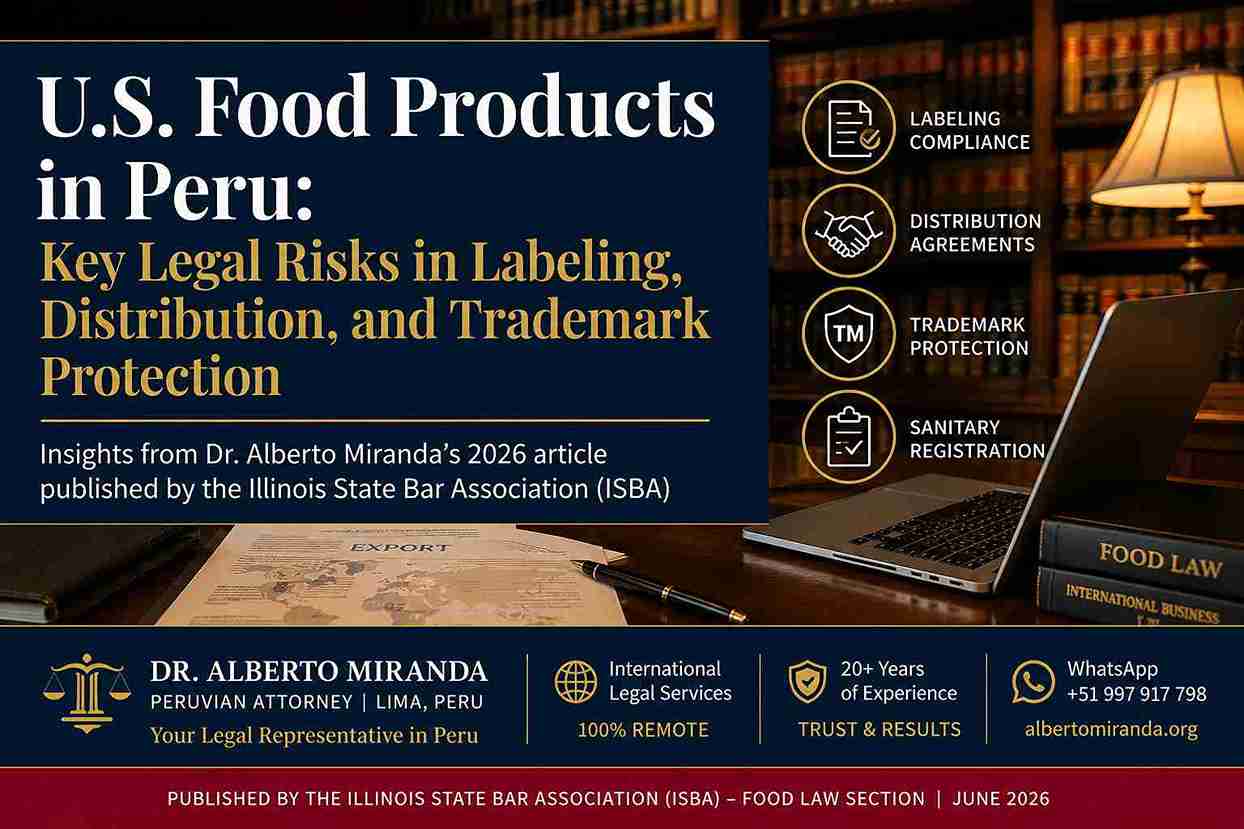
Original publication: Illinois State Bar Association · Food Law · June 2026
View Dr. Alberto Miranda’s public ISBA author profile →The full article page may require ISBA member access.
Dr. Alberto Miranda has published a new legal analysis in the Food Law newsletter of the Illinois State Bar Association, titled Selling U.S. Food Products in Peru: Key Legal Risks in Labeling, Distribution, and Trademark Protection. The article addresses the legal structure that U.S. food and agricultural businesses should review before entering the Peruvian market.
The central message is preventive: a U.S. company should not assume that selling food products in Peru follows the same logic as the U.S. import framework. Peru places significant legal weight on the correct regulatory authority, sanitary registration, the identity of the local operator, compliant Spanish-language labeling, front-of-pack warnings, and early trademark protection before INDECOPI.
What is the ISBA article about?
The article explains the practical legal risks faced by U.S. businesses that plan to commercialize food products in Peru. Rather than treating market entry as a purely commercial export issue, the analysis frames Peru as a distinct regulatory environment in which sanitary, labeling, contractual, and trademark decisions must be aligned before launch.
For foreign counsel, the relevant question is not simply whether a product can be sold in Peru. The better legal question is: which Peruvian authority regulates the product, who will hold the local filing position, what documents will support commercialization, how must the label be adapted, and whether the trademark is already protected before the brand is exposed to distributors or competitors.
Why does Peru require early regulatory classification?
Peru does not route every food product through the same authority. Processed foods and beverages are commonly linked to DIGESA, while other categories, including certain agricultural, fishery, or aquaculture products, may follow different institutional routes. This first classification step affects the permit strategy, the documentation path, and the commercial timeline.
For industrialized food products, sanitary registration becomes a central legal checkpoint. Under the Peruvian regulatory framework discussed in the article, sanitary registration authorizes manufacture, importation, and commercialization by the registration holder. That position carries regulatory responsibility and can also affect commercial leverage.
What are the main legal risks for U.S. food products in Peru?
| Risk area | Why it matters in Peru | Preventive legal action |
|---|---|---|
| Regulatory authority | Different food categories may fall under different Peruvian authorities. | Classify the product before negotiating distribution or shipment. |
| Sanitary registration | The registration holder may control the legal route to commercialization. | Define who will hold the registration and under what contractual terms. |
| Labeling | Peruvian labeling is not a mere translation of the U.S. label. | Review product name, ingredients, importer data, lot code, expiry date, and registration number. |
| Front-of-pack warnings | Imported products may need front-panel warnings or compliant adhesive labels. | Evaluate warning octagons before shipment and before packaging decisions. |
| Trademark protection | A brand may become exposed during distributor negotiations and initial market entry. | Search and file trademark protection before launch whenever possible. |
| Distribution control | The local importer or distributor may become tied to the sanitary file and label. | Draft distribution agreements that address regulatory control, transition, and termination. |
Why is labeling in Peru not just a translation issue?
A U.S. label that is commercially effective in the United States is not automatically compliant in Peru. The Peruvian framework may require specific information such as the product name, ingredients, manufacturer and importer details, sanitary registration number, expiry date when applicable, and lot code. In some cases, imported products may be adapted through an additional compliant label.
The practical mistake is to treat labeling as a last-minute translation task. Legally, labeling is connected to commercialization, consumer information, sanitary compliance, and advertising oversight. That is why it should be reviewed before the first shipment, not after the product has already entered the Peruvian distribution channel.
How do distribution agreements affect regulatory control in Peru?
In regulated product markets, the local importer or distributor is not always a neutral commercial intermediary. The local operator may be linked to the sanitary file, identified on the label, and positioned as the party that enables continued lawful circulation of the product in Peru.
For that reason, distribution agreements for food products in Peru should go beyond price, territory, exclusivity, and payment terms. They should address control over the sanitary file, responsibility for label changes, access to technical documents, inventory transition, and what happens if the commercial relationship ends.
Why should trademark protection come before market exposure?
Trademark strategy should run in parallel with sanitary and distribution strategy. In Peru, trademarks are registered before INDECOPI by class and confer exclusive rights for renewable periods. For a U.S. food business, delaying trademark review until after launch can create avoidable risk at the exact moment the brand is most visible.
Early trademark screening also helps foreign companies detect possible conflicts before negotiating with local partners. From a preventive legal perspective, the trademark filing calendar should not be separated from the regulatory and commercial launch calendar.
Five recurring mistakes when U.S. food companies enter Peru
- Failing to identify the correct Peruvian regulator before launch.
- Negotiating distribution before defining control over the sanitary registration.
- Treating labeling as a Spanish translation exercise instead of a compliance requirement.
- Discovering front-of-pack warning obligations too late.
- Postponing trademark protection until the product is already exposed in Peru.
Each of these mistakes is preventable. Once the product is already in transit, already labeled, or already committed to a local distributor, correction becomes more difficult and more expensive in practical terms.
Why this ISBA publication matters for foreign counsel
The article is especially relevant for U.S. attorneys, in-house counsel, international business lawyers, and companies that need to understand the Peruvian legal environment before advising on export, distribution, brand entry, or regulatory compliance.
Dr. Miranda advises foreign clients and international counsel from his office in Lima, Peru. His work focuses on Peruvian law, cross-border civil matters, legal coordination for foreign clients, and expert opinions on Peruvian law for international proceedings. Foreign clients do not need to travel to Peru for preliminary legal coordination.
Frequently asked questions about selling U.S. food products in Peru
Can a U.S. food company sell products in Peru using only its U.S. label?
No. A U.S. food label may need adaptation to comply with Peruvian labeling rules, including importer information, sanitary registration data, lot code, expiry date where applicable, and front-of-pack warnings when required.
Does every food product in Peru require the same permit?
No. Peru distinguishes product categories and regulatory authorities. Industrialized foods and beverages commonly involve DIGESA, while other product types may require a different institutional route.
Who should control the sanitary registration in Peru?
The answer depends on the business structure. A U.S. company should evaluate whether the importer, distributor, local affiliate, or another operator will hold the registration, because that position can affect both compliance and commercial control.
Should the distribution agreement address labeling and sanitary registration?
Yes. For regulated food products, a Peru distribution agreement should address sanitary-file control, label-change responsibility, technical documents, termination, and product transition after the relationship ends.
Should a foreign food brand register its trademark before entering Peru?
Yes. Trademark review and filing should occur before significant market exposure, distributor negotiations, or launch. In Peru, trademark protection is handled before INDECOPI and should be aligned with the regulatory entry strategy.
Do you need legal coordination for a Peru market-entry matter?
Dr. Alberto Miranda assists foreign clients, companies, and international counsel with Peruvian law matters from his office in Lima, Peru. Legal coordination can begin remotely, without traveling to Peru.
Message Dr. Miranda on WhatsApp
Dr. Alberto Miranda · Abogado peruano / Peru-qualified attorney · CAL N.º 39450 · Conciliador Extrajudicial MINJUS N.º 18991 · Más de 20 años de experiencia jurídica, especializado en derecho internacional privado / private international law · Exequátur, divorcio internacional, herencias y poderes consulares en Perú · Miembro / Member, Association of European Attorneys (AEA) · Autor publicado / Published author, Illinois State Bar Association · Atención 100% remota desde Lima, Perú / Remote legal services from Lima, Peru.