Peruvian Law Guide for Foreign Clients
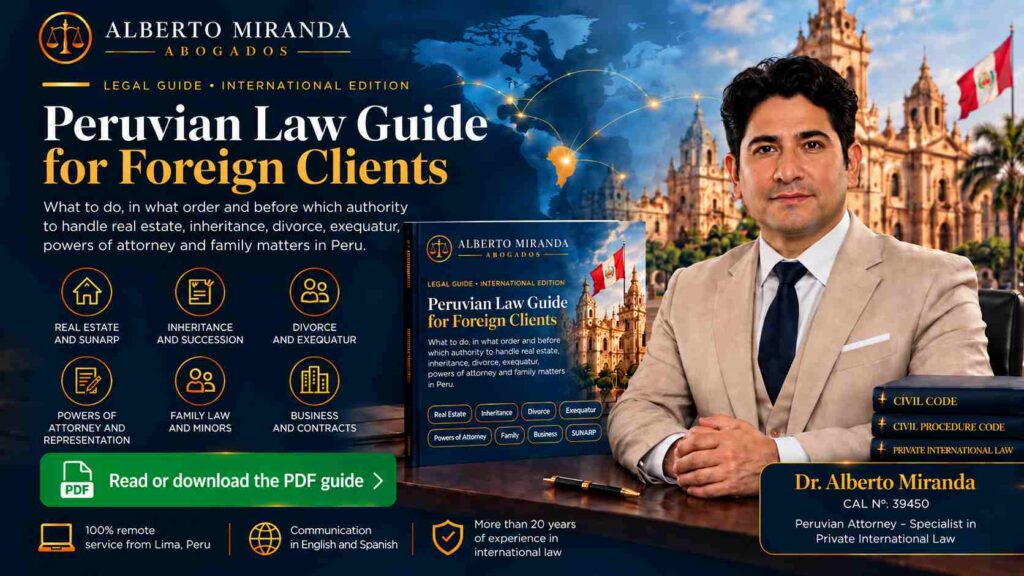
Direct answer: many legal matters in Peru can be handled from abroad when the applicable procedure permits representation. Before signing a power of attorney, transferring funds or preparing foreign documents, first determine the legal result required in Peru, the competent authority and the documents that authority will actually require.
This 18-page guide is designed for foreign clients dealing with real estate, inheritance, divorce, foreign judgments, powers of attorney, family matters, companies and contracts in Peru.
According to Dr. Alberto Miranda, a Peru-qualified lawyer (CAL No. 39450) specializing in private international law, many cross-border legal problems begin before anything is filed: with an insufficient power of attorney, the wrong supporting document or a transaction structured before the correct Peruvian legal route has been identified.
What will you learn from this Peruvian law guide?
The guide provides a practical framework for understanding a cross-border legal matter before documents are signed, powers are granted, money is transferred or proceedings are started in Peru.
Define the legal result
Determine exactly what must change legally in Peru before gathering documents or appointing a representative.
Identify the correct authority
Understand whether the matter belongs before SUNARP, RENIEC, a Peruvian notary, municipality, consulate or court.
Identify the right document
Determine which judgment, civil record, registry document, title or certificate actually proves the relevant fact or right.
Check foreign-document formalities
Distinguish between apostille, legalization, Spanish translation and substantive sufficiency before filing documents in Peru.
Structure representation properly
Confirm whether representation is permitted and which express powers the attorney-in-fact must receive.
Plan execution
Determine what must happen after the deed, judgment, succession or other legal act has been obtained.
The recommended order is result → authority → document → formality, followed by representation → execution. Only after those questions are answered can the power of attorney be drafted for the specific act to be performed in Peru.
What legal matters does the guide cover?
Real estate
Ownership, SUNARP records, encumbrances, seller authority, powers of attorney, payment structure and registration.
Inheritance and succession
Applicable law, intestate succession, wills, forced heirship, foreign probate documents and assets located in Peru.
Divorce and exequatur
Divorce in Peru, recognition of foreign divorce decrees and other foreign judgments, and subsequent registration.
Powers of attorney
Peruvian consular powers, foreign notarized instruments, special powers, apostille, translation and SUNARP registration.
International family matters
Marriage by proxy, cohabitation, custody, visitation, child support, relocation and the 1980 Hague Convention.
Companies and contracts
Corporate powers, contracts, registry checks, due diligence, asset searches and legal representation in Peru.
What should you review before signing, paying or sending documents?
The guide uses a six-step sequence intended to reduce avoidable filings, duplicate formalities and transactions based on incomplete information.
Who is this guide designed for?
Individuals with property, family relationships, inheritance, foreign judgments or other legal matters connected with Peru.
Foreign investors and businesses requiring registry checks, contract analysis, representation or due diligence in Peru.
Counsel whose litigation, transaction or client matter depends on Peruvian law or requires execution before a Peruvian authority.
What happens when your matter requires individual legal analysis?
Preventive legal evaluation
The initial contact is used to confirm whether the matter falls within the practice. When it does, a preventive legal evaluation is proposed and quoted in advance.
Once accepted, the relevant facts and documents are reviewed to determine the legal route, principal risks, formalities and, where representation is appropriate, the powers that will be required.
Any subsequent execution is governed by a written proposal defining scope, deliverables and professional fees.
Dr. Alberto Miranda — Peruvian Law Expert
Dr. Alberto Miranda is a Peru-qualified lawyer registered with the Lima Bar Association (CAL No. 39450), founder of Alberto Miranda Abogados and an Extrajudicial Conciliator accredited by Peru's Ministry of Justice (MINJUS No. 18991).
With more than twenty years of professional practice, he advises foreign clients, Peruvians abroad and international counsel on private international law, civil matters, family law, succession, registry and notarial matters connected with Peru.
His qualifications were submitted to the High Court of Justice, Family Division (England & Wales), which approved his participation as a joint expert on Peruvian family law in a 1980 Hague Convention proceeding.
100% remote legal service from Lima, Peru, with written communication in English.
Does your case depend on a question of Peruvian law?
Dr. Miranda provides independent written legal opinions on Peruvian law and acts as local counsel in Peru for foreign lawyers and international law firms.
Instructions may involve family law, succession, recognition of foreign judgments, real estate, contracts, registry searches or other cross-border civil matters governed by Peruvian law.
Questions foreign clients ask about legal matters in Peru
Can a foreign client handle a legal matter in Peru without traveling?
Many legal matters can be handled through representation when the applicable procedure permits it, the power of attorney contains the required authority and the supporting documents satisfy Peruvian formalities.
Does a foreign power of attorney automatically work in Peru?
No. Its form, legalization, translation, registration and powers must satisfy the requirements of the particular act to be performed.
Does an apostille make a foreign document sufficient in Peru?
No. An apostille addresses authenticity. The document must also satisfy language requirements and prove exactly what the Peruvian authority needs to verify.
Does a foreign divorce automatically change civil status in Peru?
As a general rule, and subject to any applicable treaty, a foreign divorce judgment requires recognition through exequatur before its effects can be recorded in Peru.
Can legal work be handled in English?
Yes. Written communication, reports and legal opinions may be provided in English, with 100% remote legal service from Lima, Peru.
Is the preventive legal evaluation free?
No. The preventive legal evaluation is a professional service quoted in advance after an initial pre-screening confirms that the matter falls within the practice.
Need to resolve a legal matter in Peru from abroad?
If you are still defining the issue, start with the guide. If you already have a judgment, property transaction, inheritance, power of attorney, family matter, contract or active proceeding, request a preventive legal evaluation to determine the appropriate Peruvian legal route.
This page provides general information on Peruvian law and does not constitute a legal opinion on any specific matter. Administrative, consular, registry and judicial requirements should be verified in light of the facts, documents, jurisdiction of origin and objective of each case. Reading this page or contacting Dr. Miranda does not create an attorney-client relationship; a professional relationship arises only through a formal engagement.