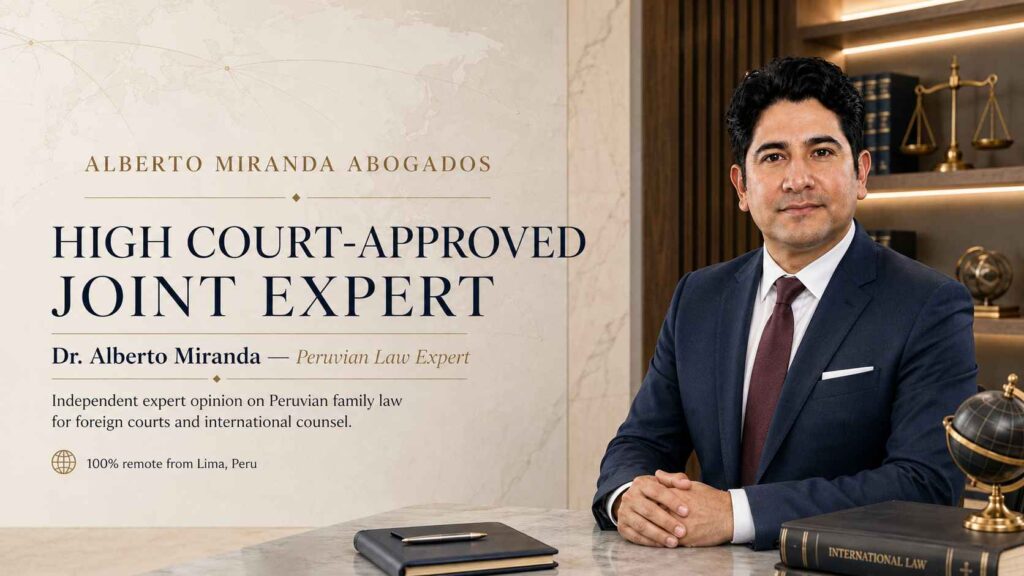
A professional record of how Dr. Alberto Miranda’s qualifications were submitted to the High Court of Justice, Family Division, and approved for his participation as a joint expert on Peruvian family law.
According to Dr. Alberto Miranda, a Peru-qualified attorney admitted to the Lima Bar Association (CAL No. 39450) and specializing in private international law, foreign courts require clear, independent and properly sourced explanations when the content or legal effect of Peruvian law is relevant to cross-border proceedings.
This article records a specific professional experience involving the High Court of Justice, Family Division, England & Wales. It does not disclose the parties, children, case number, documents, expert questions, conclusions, procedural outcome or other confidential information from the underlying proceedings.
How did Dr. Alberto Miranda’s High Court expert assignment arise?
The initial approach came from solicitors acting for the respondent. Dr. Miranda’s professional qualifications were then submitted to the court, which approved his participation in the proceedings.
Solicitors representing the respondent initially contacted Dr. Alberto Miranda after identifying the need for specialist evidence on Peruvian family law. Dr. Miranda provided his professional CV and details of his Peruvian legal qualifications and experience.
Those qualifications were presented to the judge for consideration. Following the court’s approval, Dr. Miranda proceeded to act as a joint expert on the relevant questions of Peruvian family law.
Initial professional approach
Solicitors acting for the respondent contacted Dr. Miranda regarding the need for expert evidence on Peruvian family law.
Submission of qualifications
His professional CV, Peruvian bar qualification and relevant experience were submitted through counsel for judicial review.
High Court approval
The court approved Dr. Miranda’s participation as a joint expert on the defined questions of Peruvian family law.
Materials from both parties
Solicitors representing both parties supplied relevant documents for the preparation of the independent expert report.
The initial contact from one side did not make Dr. Miranda an advocate or private expert for that party. Once his participation was approved and the joint expert assignment proceeded, the professional function required independent analysis for use within the court proceedings.
What did the High Court approve?
The court approved Dr. Miranda’s participation after his professional qualifications had been presented for consideration. The approval related to a specific proceeding and a defined field of expertise: Peruvian family law. It did not create a permanent appointment or continuing institutional status with the High Court.
Expert evidence in family proceedings is subject to judicial control. Under Part 25 of the Family Procedure Rules , the court controls whether expert evidence may be placed before it and may direct that evidence on a particular issue be provided by a joint expert.
In Dr. Miranda’s case, his CV and professional background were submitted to the judge and approved before he completed the expert assignment. The precise description is therefore case-specific: his professional qualifications were submitted to the court and his participation as a joint expert on Peruvian family law was approved for that proceeding.
The approval applied to a specific proceeding. It did not create a permanent appointment, institutional affiliation, judicial position or continuing status as an expert of the High Court.
What did acting as a joint expert mean?
Acting as a joint expert meant that the report was not prepared as partisan advocacy for only one side. The relevant materials were provided through solicitors for both parties and the expert analysis had to remain independent.
The Family Procedure Rules provide that, where expert evidence is to be supplied through a joint expert, the instructions are ordinarily contained in a jointly agreed letter unless the court directs otherwise. They also regulate the provision of separate instructions and require transparency between the parties.
In practical terms, Dr. Miranda’s task was to address the authorized Peruvian-law questions, review the relevant materials, identify the applicable Peruvian legal framework and present conclusions that could be understood within a foreign judicial proceeding.
- The expert field was limited to Peruvian family law.
- Materials were received through solicitors representing both parties.
- The analysis was not prepared as advocacy for the respondent or the applicant.
- The report had to distinguish legal sources, factual assumptions and professional conclusions.
- Any uncertainty or limitation had to be identified rather than concealed.
A broader explanation of the structure and function of this type of evidence is available in the separate guide on court-ready expert reports on Peruvian law .
Why was professional independence essential?
An expert in family proceedings owes an overriding duty to the court. That duty takes priority over any obligation to the person who first contacted, instructed or paid the expert.
The duties of experts in family proceedings are addressed in Practice Direction 25B . The expert must assist the court, provide an opinion independent of the instructing parties and remain within the boundaries of the expert’s professional knowledge and experience.
For a Peruvian-law opinion, this requires separating at least three elements:
- The documents and factual assumptions provided by counsel.
- The relevant Peruvian legislation and legal authorities.
- The expert’s reasoned professional interpretation and conclusions.
Legal research and drafting technology may assist the preparation of a document. It cannot replace the independence, jurisdictional qualification, professional judgment and personal responsibility of the expert who signs the conclusions.
This is particularly important when Peruvian legal concepts must be explained to judges and lawyers trained in another legal system. The expert must make the Peruvian framework understandable without inaccurately converting it into an English legal institution.
Why was Peruvian family law relevant to the proceedings?
A foreign court may need expert assistance when its decision depends on the content, interpretation or effect of Peruvian family law.
International family proceedings may involve parents, children, residence, parental responsibility, custody rights, foreign court orders or civil-status consequences connected with more than one jurisdiction.
The Courts and Tribunals Judiciary explains that the Family Division of the High Court hears a limited number of family matters, including proceedings involving international child abduction.
The proceedings in which Dr. Miranda participated were connected with the 1980 Hague Convention on the Civil Aspects of International Child Abduction . The Convention establishes an international framework concerning the prompt return of children wrongfully removed or retained and the effective protection of custody and access rights.
This article does not reproduce the specific legal questions submitted to Dr. Miranda. Those questions, the documents reviewed and the conclusions of the report remain confidential.
Foreign lawyers seeking analysis specifically concerning Peruvian family law may review the dedicated page on Peruvian Family Law Expert Opinions .
Why are the case details not disclosed?
The underlying matter concerned private family proceedings. Protecting the parties, children, documents and confidential facts takes priority over publishing a detailed account of the dispute.
For that reason, this professional record does not identify:
- The applicant or respondent.
- Any child connected with the proceedings.
- The court file or case number.
- The solicitors or firms involved.
- The precise questions submitted to the expert.
- The underlying documents or factual allegations.
- The conclusions or recommendations contained in the report.
- The procedural result of the case.
The absence of those details is not a weakness in the professional credential. It reflects the confidentiality and restraint expected in sensitive international family proceedings.
The professional assignment may be described. The private case should not be reconstructed through names, initials, dates, quotations, nationalities, procedural events or partially redacted documents that could allow the parties or children to be identified.
What does the High Court approval demonstrate professionally?
It provides concrete evidence that Dr. Miranda’s professional qualifications were evaluated for use in a foreign judicial proceeding and that he completed an independent assignment involving Peruvian family law.
The significance does not depend on an honorary title. It arises from the professional process itself: judicial review of his qualifications, participation under a defined expert scope, receipt of materials from both sides and preparation of conclusions for use in proceedings before a foreign court.
- Judicial consideration and approval of his professional qualifications for the specific proceeding.
- Experience explaining Peruvian family law within an English judicial context.
- Ability to explain Peruvian legal concepts in written expert analysis for foreign solicitors and a foreign court.
- Compliance with a defined expert-evidence scope and professional independence requirements.
- Review of documents supplied through solicitors representing both parties.
- Personal professional responsibility for the legal analysis and conclusions contained in the report.
Dr. Miranda’s admissions, professional history, international credentials and public authority signals are presented separately in his attorney profile and professional qualifications .
His books, Illinois State Bar Association contributions and other legal publications are organized within Legal Publications by Dr. Alberto Miranda .
What does this experience mean for international counsel?
It gives instructing counsel a concrete example of Dr. Miranda having worked within a foreign court-controlled expert process involving questions of Peruvian law.
Foreign lawyers do not need only a document containing Peruvian legal references. They may need an identifiable Peru-qualified professional capable of explaining the law independently, defining the limits of the opinion and accepting responsibility for the methodology and conclusions.
The primary service page for these instructions is Peruvian Law Expert for Foreign Courts . Broader professional coordination for international firms is explained under Services for International Law Firms .
Which official sources explain the applicable framework?
The institutional framework may be reviewed directly through official sources from Justice UK, the Courts and Tribunals Judiciary and the Hague Conference on Private International Law.
Does a foreign proceeding require an opinion on Peruvian law?
International law firms and instructing counsel may submit the jurisdiction, court deadline, specific Peruvian-law questions and proposed scope for professional review. Services are coordinated 100% remotely from Lima, Peru, without requiring the client to travel to Peru.
Frequently asked questions about the High Court expert assignment
Was Dr. Alberto Miranda selected directly by the judge?
Dr. Miranda was initially identified and contacted by solicitors for the respondent. His professional CV and qualifications were then submitted to the judge, and the court approved his participation as a joint expert on Peruvian family law.
Was Dr. Miranda acting only for the respondent?
No. Although the initial professional approach came from solicitors for the respondent, Dr. Miranda’s participation proceeded as a joint expert assignment. Solicitors for both parties provided relevant documentation for the independent expert report.
What area of law did the report concern?
The assignment concerned defined questions of Peruvian family law within proceedings connected with the 1980 Hague Convention. The specific questions, documents and conclusions remain confidential.
Did Dr. Miranda advise on English law?
No. Dr. Miranda is admitted to practise law in Peru. His role was limited to explaining Peruvian law and did not include advising on English law or acting as a solicitor or barrister in England and Wales.
Is Dr. Miranda a permanent expert of the High Court?
No. The court’s approval related to a specific proceeding. It did not create a permanent appointment, judicial office or institutional affiliation with the High Court.
Can international counsel request another Peruvian-law opinion?
International counsel may request an independent opinion on Peruvian law, subject to availability, conflict review, a defined written scope, professional independence, appropriate documentation and confirmed engagement terms.
Dr. Alberto Miranda
Peru-qualified attorney admitted to the Lima Bar Association under CAL No. 39450, founder of Alberto Miranda Abogados and specialist in private international law and cross-border civil matters involving Peru. Published author in the Illinois State Bar Association, member of the Association of European Attorneys (AEA), Vice President for Providing Legal Expert Opinions at Justinian Lawyers, and Listed Arbitrator — AEA Arbitration Court Berlin. Attention 100% remote from Lima, Peru.
Legal notice: This article records a case-specific professional experience and provides general information only. It does not disclose the identities, children, documents, questions, evidence, conclusions or outcome of the underlying proceedings. Dr. Alberto Miranda practises Peruvian law exclusively and is not admitted as a solicitor or barrister in England and Wales. No attorney-client relationship is created through this publication.