How to Sell Inherited Property in Peru from Abroad: Registry, Co-Heirs and Powers of Attorney
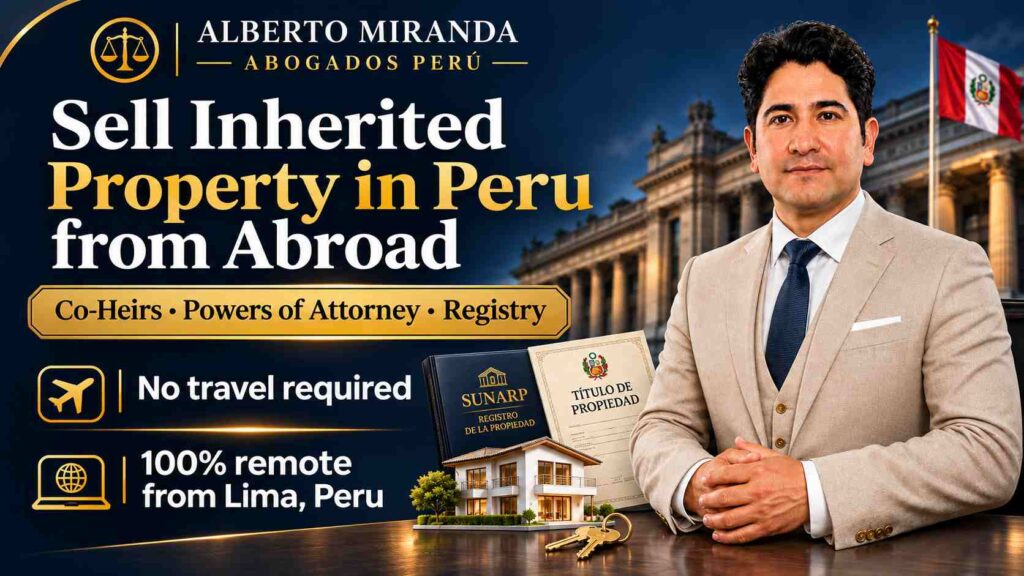
Inherited real estate · Peruvian law · Heirs living abroad
Inherited property in Peru can often be sold while the heirs remain abroad. According to Dr. Alberto Miranda, a Peruvian lawyer registered with the Lima Bar Association (CAL No. 39450) specializing in private international law, a legally sound sale begins by confirming the succession, the property’s registry history, who is entitled to transfer it and whether each seller can act through a valid power of attorney.
A property may be held by one heir or by several co-owners. Selling the entire property ordinarily requires all persons whose rights are being transferred to participate or be properly represented. Powers executed abroad must satisfy the applicable legal-form requirements; an apostille alone does not make every foreign notarial document sufficient for a property sale in Peru.
Alberto Miranda Abogados reviews the succession and property registry records, advises on the appropriate power of attorney, and coordinates the Peruvian notarial and registry stages within an agreed scope. Professional instructions are managed 100% remotely from Lima, Peru; any required local formalities are handled through the appropriate authorities or representatives.
Each matter starts with a review of the property's registry file and the succession documents.
What Should Heirs Know Before Selling Inherited Property in Peru?
Registry status matters
A succession and the resulting transfer to the heirs must be reflected in the relevant registries for the purchaser's ownership to be registered.
Entire property or one share?
A sale of the whole jointly owned property requires the relevant co-owners' participation. A transfer of an individual ideal share is legally different.
Representation can avoid travel
A properly drafted public-deed power may permit an heir to complete the Peru-side sale through an attorney-in-fact, subject to the case.
Can You Sell Inherited Property in Peru Without Traveling?
Often yes. An heir abroad may appoint an attorney-in-fact to sign the sale in Peru. Article 156 of the Peruvian Civil Code requires authority to dispose of the principal's property to be unequivocal and granted by public deed, under penalty of nullity. A general authority limited to administration is not sufficient.
- Peruvian consular public deed: a practical route for heirs abroad, with express powers to sell and to complete the agreed transaction.
- Foreign notarial instrument: may be considered only after checking whether its form and legal effect satisfy Peruvian requirements. An apostille or legalization, and a translation where necessary, address authentication and language; they do not cure an insufficient legal form or missing powers.
- Authority adapted to the transaction: review who may negotiate and sign, receive the purchase price, complete tax formalities, deliver possession and apply for registration. Receiving payment should not be presumed unless authorized.
Registration of the power is not always a separate prior step. Under SUNARP's Regulation on the Registry of Mandates and Powers (Resolution No. 00241-2026-SUNARP/SN), certain registrable dispositions by an attorney-in-fact may proceed by incorporating or attaching the appropriate notarial or consular instrument, without first registering the power separately. The registry officer still verifies the powers and relevant records. The exact documentary route must be checked before signing.
Electronic submission of consular documents is available through participating consular services and the applicable SUNARP channels; availability and requirements should be confirmed for the consulate concerned. A power may terminate upon the death of the principal or attorney-in-fact, and a registry annotation of termination does not itself cause that termination. For more information, see powers of attorney for Peru from abroad.
What Should Be Checked Before an Inherited Property Is Sold?
A buyer and the Peruvian notary will need a reliable chain of title. The legal effect of inheritance and the steps required for registry inscription should not be confused. The principal checks include:
- Succession title: confirm the registered declaration of heirs or the will and identify everyone entitled to the property.
- Property registry: verify the transfer by succession in the property's SUNARP record, or plan the necessary sequential registry acts before or together with registration of the sale as legally permitted.
- Shares and family rights: identify co-owners, possible matrimonial property interests, minors, outstanding successions and any other rights relevant to the deed.
- Encumbrances and restrictions: examine mortgages, attachments, pending entries and any legal or contractual obstacles.
- Property and municipal records: check identity, area, registered buildings, property tax and local municipal obligations relevant to the closing.
SUNARP's Succession and Wills Registration Regulation, Articles 52 and 53, distinguishes registration of the succession from entry of the resulting property transfer in the asset register. If the succession has not been completed, that phase must be assessed before the sale can be registered. Read our guides to Peru inheritance and the public registry and inheritance in Peru after a death abroad.
Do All Co-Heirs Have to Sign the Sale?
For a voluntary sale of the entire property held in co-ownership, the co-owners whose rights are being sold ordinarily must participate or be represented. Article 971 of the Civil Code provides for unanimity to dispose of the common property. Article 977 separately permits a co-owner to dispose of their own ideal share. These are not interchangeable transactions.
| Situation | Who participates? | Legal point |
|---|---|---|
| One registered owner | That owner or a duly authorized attorney-in-fact | Check other interests or restrictions before the sale |
| Several co-owners selling the entire property | All co-owners whose interests are transferred, personally or through valid representation | Unanimity under Civil Code Article 971 |
| One co-owner selling only an ideal share | That co-owner | Article 977 permits disposition of the share; a statutory right of redemption (retracto) may arise on a sale to an outsider |
| Surviving spouse or other matrimonial interest | Depends on title, matrimonial property regime and succession rights | Do not assume the spouse's capacity or share from marital status alone |
| Minor heir | Legal representative, subject to the required judicial authorization | Special safeguards apply to disposition of a minor's property |
| A co-owner objects to selling the entire property | No ordinary consensual sale of the whole property without that interest | Possible alternatives include a negotiated buyout, sale of an ideal share or partition proceedings |
The statutory right of retracto, when applicable to a sale of an undivided share to an outsider, is not the same as a general requirement to obtain prior consent from the other co-owners.
Does the Heir's Spouse Need to Sign?
Under Article 302 of the Peruvian Civil Code, property acquired by inheritance is generally the heir's separate property in the relevant Peruvian matrimonial regime. A spouse is not required to join a sale merely because the heir is married.
However, a surviving spouse may separately have matrimonial property rights in the deceased's estate or inheritance rights, and a marriage involving another country can raise questions of applicable law. The title, succession and matrimonial property regime should therefore be reviewed before deciding who must sign. See marriage abroad and property in Peru.
How Is the Sale Executed and Registered?
Preparing and signing
- Confirm the sellers, title, sale terms and required powers.
- Review the draft agreement and Peruvian notarial documents.
- Arrange execution before the Peruvian notary by the owners or their lawfully authorized attorneys-in-fact.
- Plan the documented payment method and any tax withholding before the price is released.
Registration and closing
- Present the notarial instrument and other required documents for SUNARP registration.
- Complete or coordinate necessary preceding succession-related registry entries.
- Verify registration of the buyer's title.
- Document possession, tax compliance and distribution of sale proceeds under the agreed terms.
Peruvian rules on the use of financial-system payment methods and notarial identification of the means of payment must be assessed for the price and transaction. An informal cash arrangement may create significant tax, evidentiary and registration difficulties.
What Taxes Apply When Selling Inherited Property in Peru?
Peru does not levy a general inheritance tax on the mere receipt of an inheritance. A later property sale is a separate taxable event and must be evaluated for each seller.
- Seller's income tax: taxation depends on the seller's Peruvian tax-domicile status, the character of the transaction and the applicable cost and documentation rules. Heirs living abroad are not automatically subject to the same procedure as tax residents.
- Non-domiciled sellers: SUNAT provides specific rules for the sale of Peruvian real estate by non-domiciled persons, including withholding duties in qualifying transactions. The payment structure should be reviewed before closing.
- Acquisition cost of inherited property: special rules may apply to the computation and documentation of the property's tax basis. Do not assume that an inheritance appraisal or the property's current value automatically becomes the tax cost.
- Municipal transfer tax (alcabala): generally borne by the buyer or acquirer, subject to the statutory rules and exemptions.
- Municipal property obligations: outstanding property tax and relevant municipal charges should be verified and addressed at closing.
Before agreeing on the net sale proceeds: each heir's tax status and the transaction's documentary requirements should be reviewed with a qualified Peruvian tax adviser where appropriate. The applicable liability cannot be determined from the property's sale price alone.
Can Sale Proceeds Be Transferred Abroad?
Generally, the lawful proceeds of a Peruvian property sale may be transferred to an account abroad. Peru protects the holding and disposal of foreign currency, but international bank transfers remain subject to tax compliance, source-of-funds documentation, banking checks, applicable anti-money-laundering rules and the receiving country's requirements.
Before closing, establish who is entitled to each payment, the account details, the documentary trail and whether any withholding or other obligations must be satisfied.
Which Mistakes Can Delay or Put an Inherited Property Sale at Risk?
- Assuming that any notarized, apostilled foreign document is sufficient as a public-deed power to sell.
- Failing to examine succession registration and the chain of title for the specific property.
- Confusing a sale of one heir's ideal share with a sale of the entire property.
- Using a power without unequivocal authority for the proposed disposal, or relying on a power that has terminated.
- Overlooking the matrimonial rights, legal capacity or judicial-authorization requirements of an owner.
- Agreeing on payment and remittance before confirming the applicable tax, banking and documentation obligations.
How Does Alberto Miranda Abogados Coordinate the Sale from Abroad?
Core legal coordination
- Registry and succession review: assess the property's record, the heirs' title, registered burdens and relevant restrictions.
- Representation: draft and review the proposed powers and identify the appropriate consular or foreign-notarial route.
- Notarial coordination: review the agreed terms and coordinate the deed with a Peruvian notary and authorized signatories.
- Registration follow-up: monitor the registry submission and identify observations within the agreed scope.
Additional work when needed
- Intestate succession or registration of a will not yet completed.
- Negotiation among heirs or a separate partition proceeding.
- Assessment of foreign judgments when recognition may be required.
- Coordination with a tax adviser and assistance with additional formalities when legally feasible.
Scope and deliverables are confirmed after reviewing the documents; no registration or sale outcome is promised in advance.
Who Is Responsible for Your Matter?
Dr. Alberto Miranda personally assesses and directs each matter. He is a lawyer registered with the Lima Bar Association (CAL No. 39450), founder of Alberto Miranda Abogados and a private international law practitioner with more than twenty years of professional experience.
He is Vice President for Providing Legal Expert Opinions at Justinian Lawyers, and his legal articles have been published by the Illinois State Bar Association. His professional qualifications were submitted to the High Court of Justice, Family Division, England & Wales, which approved his participation as a joint expert on Peruvian family law in a specific proceeding.
Verify his international professional roles or read his ISBA publication record.
Can the Process Be Managed Without Traveling to Peru?
In many cases, yes. Alberto Miranda Abogados provides 100% remote legal service from Lima, Peru. Instructions, document assessment and coordination are handled remotely. Heirs can execute the legally appropriate power where they reside; duly authorized representatives handle the agreed notarial acts in Peru. Consular appearances, foreign-notarial formalities or other personal steps outside Peru may still be required, and the feasibility of avoiding travel is evaluated case by case.
Frequently Asked Questions About Selling Inherited Property in Peru
Can inherited property in Peru be sold without traveling there?
Often yes. An heir abroad may authorize a representative to complete the Peru-side sale by a legally sufficient public-deed power. The requirements depend on the succession, the property, the place where the power is granted and the agreed transaction.
Must the succession be registered before the buyer can register the sale?
The relevant succession title must be registered, and the resulting chain of title must be reflected in the appropriate SUNARP records. Necessary entries may be coordinated in sequence according to the applicable registry procedure. An unregistered succession should be reviewed before a sale is completed.
Do all heirs have to agree to sell the whole property?
Where the property is held in co-ownership, a consensual disposition of the entire property ordinarily requires the participation of all co-owners whose rights are transferred. A co-owner may dispose of an ideal share separately, subject to applicable legal rights such as retracto.
Is an apostilled foreign power of attorney sufficient to sell?
Not automatically. Article 156 of the Peruvian Civil Code requires unequivocal disposal authority in a public deed. A foreign document must be assessed for its legal form and effects in Peru. Apostille or legalization authenticates the document but does not cure an insufficient power.
Must a power be registered separately before selling inherited property?
Not in every case. SUNARP's Regulation on the Registry of Mandates and Powers permits certain property dispositions through an attorney-in-fact without prior separate registration of the power, subject to attaching the required notarial or consular instrument and registral verification.
Does an heir's spouse need to sign the sale?
Not solely because the heir is married. Under Peruvian law, inherited property is generally separate property within the applicable matrimonial regime. However, succession rights, marital property interests and cross-border applicable-law issues must be examined for the particular property.
Does selling inherited real estate in Peru trigger taxes?
It may. Peru has no general inheritance tax on receipt of an inheritance, but the subsequent sale may create income-tax obligations. Special procedures can apply to non-domiciled sellers, and municipal alcabala is generally borne by the buyer. Each seller's position should be checked before closing.
Can I receive the sale proceeds in a foreign bank account?
Generally yes, subject to tax compliance, identity checks, lawful source-of-funds documentation, financial institution procedures and requirements in the receiving country. The remittance arrangements should be agreed before the deed is signed.
Which Related Guides May Help?
Which Official Sources Support This Guide?
- Peruvian Civil Code, including Articles 156, 302, 447, 971, 977 and the applicable rules on retracto.
- SUNARP — Regulation on the Registration of Wills and Intestate Successions, Articles 52 and 53.
- El Peruano — SUNARP's Regulation on the Registry of Mandates and Powers.
- Peruvian Ministry of Foreign Affairs — Consular public-deed powers for property transfers and electronic consular submissions.
- SUNARP — Foreign-executed powers and documentary requirements.
- SUNAT — Income tax and cost basis on inherited property and obligations of non-domiciled sellers.
- Metropolitan Lima Tax Administration — Municipal transfer tax (alcabala).
For heirs living abroad and instructing counsel
Need to Sell an Inherited Property in Peru?
Send the property's location or SUNARP registry number, the known heirs, their countries of residence and the current succession status. We assess the title, the representation options and the Peru-side steps before proposing a defined legal engagement.
International law firms: counsel@albertomiranda.org. Please do not send confidential case materials before the terms of engagement are confirmed.
This page provides general information about Peruvian succession, property, notarial, registry and related tax issues. Requirements depend on the property's title, heirs, applicable law and authorities involved. It is not advice for an individual matter and does not create an attorney-client relationship. Alberto Miranda Abogados provides Peru-side legal services; foreign legal or tax advice is addressed through appropriate professionals where needed.