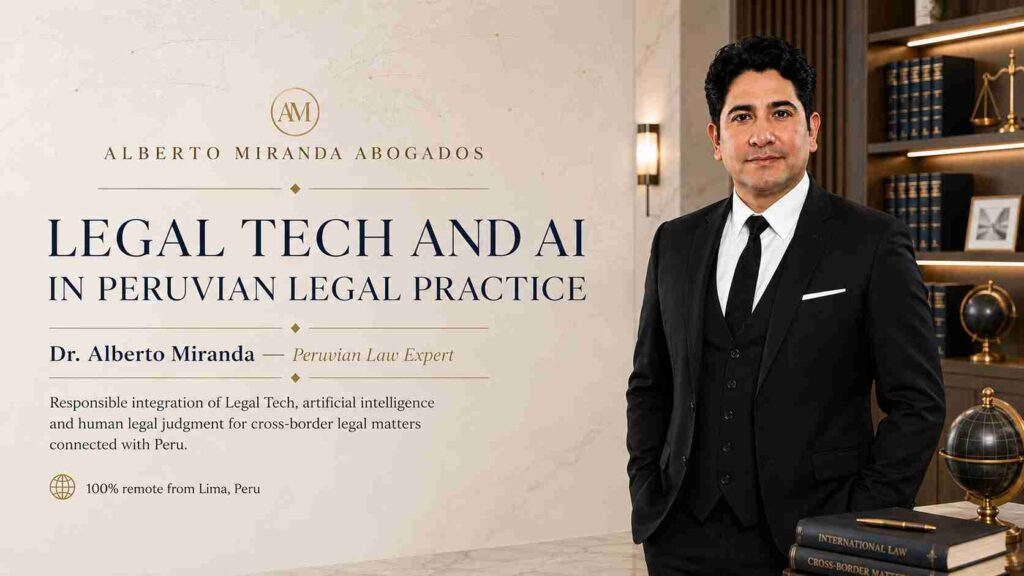
Legal Tech and AI in Peruvian Legal Practice: Dr. Alberto Miranda’s Professional Methodology
Technology can strengthen legal work when it is used as an assistive layer — not as a substitute for verified legal sources, confidentiality safeguards, professional judgment, or responsibility for the final legal analysis.
Peru-qualified attorney · Lima Bar CAL No. 39450 · International Private Law
According to Dr. Alberto Miranda, a Peru-qualified attorney (Lima Bar, CAL No. 39450) specializing in international private law, Legal Tech and AI can improve organization, research mapping and cross-border workflow, but they do not replace source verification, confidentiality safeguards, professional judgment or the lawyer’s responsibility for the final legal analysis.
Why should an international lawyer understand Legal Tech and AI?
Cross-border legal work combines law, documents, institutions, deadlines, languages and procedural formalities. Legal Tech can help control that complexity. Its value lies in improving workflow and analytical organization while preserving the lawyer’s independent judgment over applicable Peruvian law, evidentiary significance, procedural strategy and the final advice delivered to the client.
International legal matters connected with Peru frequently require more than reading a statute. A single engagement may involve a foreign judgment, a Peruvian court, a consular power of attorney, an apostille or legalization pathway, official translations, SUNARP records, RENIEC data, notarial formalities and communication with counsel or clients located in another jurisdiction.
In that environment, technology is useful when it helps the lawyer organize complexity without obscuring responsibility. A well-designed technological workflow can reduce repetitive work, structure large document sets, identify factual inconsistencies, map legal issues and make cross-border coordination more disciplined.
The governing principle
Technology may assist the legal process. It does not become the legal decision-maker. The lawyer remains responsible for selecting authoritative sources, interpreting Peruvian law, evaluating the facts, protecting confidential information, defining strategy and approving every professional conclusion.
Which legal tasks can receive technological assistance?
Technological assistance is most useful in tasks that improve structure, visibility and consistency: document organization, chronology building, issue mapping, comparison of versions, research planning and first-stage drafting frameworks. These uses can increase efficiency without transferring the lawyer’s legal judgment to an automated system.
Document organization
Classifying judgments, certificates, powers of attorney, registry records, correspondence and supporting evidence so the legal file can be reviewed in a controlled sequence.
Chronology building
Ordering dates, procedural events and documentary milestones to identify gaps, contradictions or deadlines that require legal attention.
Issue mapping
Separating factual questions from legal questions and identifying which issues require verification against Peruvian statutes, regulations, judicial decisions or official records.
Comparison and consistency
Comparing document versions, names, dates, defined terms or factual statements to detect inconsistencies before a filing, opinion or legal instrument is finalized.
Research planning
Creating a research map of institutions, legal concepts and potential sources that must later be checked against authoritative Peruvian materials.
Drafting frameworks
Structuring headings, factual matrices, issue lists or preliminary analytical frameworks that remain subject to substantive legal review and redrafting by the lawyer.
The practical advantage is not that a system “knows the law.” The advantage is that the lawyer can use tools to reach the verification and judgment stage with a better-organized file. That distinction is central to responsible use.
Which tasks must remain under human legal review?
Core professional decisions must remain human: identifying the controlling legal rule, assessing the reliability of a source, interpreting its effect on the facts, evaluating evidence, selecting procedural strategy, advising the client and signing or approving the final work product. Automation cannot assume professional responsibility for those decisions.
- Determining applicable Peruvian law. A legal conclusion must be based on the governing legal framework, not on generated text.
- Assessing legal authority. A statute, regulation, judicial ruling, administrative criterion or registry record has a different legal function and weight.
- Interpreting facts and evidence. The relevance of a document depends on the legal question, the procedural context and what the document actually proves.
- Defining legal strategy. Choosing whether, when and how to file, negotiate, execute a power, request a record or pursue recognition of a foreign decision requires professional judgment.
- Communicating legal advice. Advice must reflect the actual facts, risks and objectives of the client rather than a generic automated response.
- Approving the final work product. Legal opinions, court submissions, contracts, powers of attorney and client communications require human review before use.
This is particularly important in cross-border matters, where a seemingly minor error — a name mismatch, a missing finality certificate, an inadequate power, a mistranslated legal term or an incorrect assumption about jurisdiction — can affect the entire procedural route.
How are Peruvian legal sources verified?
A reliable legal workflow separates source discovery from source authority. Technology may help locate a legal issue or organize possible references, but the relevant proposition must be checked against authoritative Peruvian sources and read in its procedural context before it is used in advice, a filing or an expert opinion.
For a focused analysis of the risks of relying on AI-generated statements about Peruvian law, see Can AI Reliably Explain Peruvian Law? What Foreign Lawyers and Courts Should Verify .
For foreign counsel and courts, this distinction is even more important. An expert report on Peruvian law must allow the reader to understand what the relevant Peruvian source is, what it says, how it operates and why it matters to the issue before the foreign tribunal.
How should confidentiality be protected when technology is used?
Confidentiality must be addressed before any technological tool is used with client information. The relevant question is not merely whether a platform is convenient, but what information is necessary, whether personal or sensitive data can be minimized, and whether the proposed workflow is appropriate for the professional duty attached to the matter.
A responsible workflow starts with data minimization. If a task can be completed without a client’s full name, identification number, address, financial data, medical information, litigation strategy or confidential correspondence, that information should not be unnecessarily introduced into the technological process.
It also requires separation between generic analytical assistance and confidential case material. Not every tool or workflow is suitable for every document. The degree of sensitivity must be assessed before use, particularly in family, succession, asset, corporate or litigation matters.
How does this methodology apply to cross-border Peruvian legal matters?
The methodology is especially useful when a matter crosses jurisdictions and institutions. It helps organize foreign documents, Peruvian requirements, factual timelines and source verification while keeping the substantive legal analysis under the lawyer’s control. The objective is a clearer, auditable path from documents to legal conclusion and execution.
Foreign judgments and exequatur
Organizing judgments, finality evidence, translations and procedural requirements before analyzing the Peruvian recognition pathway.
International succession
Mapping family relationships, death and civil-status records, assets, registry information and succession issues before applying Peruvian inheritance law.
Consular powers of attorney
Controlling identities, powers granted, intended acts, institutional requirements and the relationship between the instrument and the procedure to be performed in Peru.
Peru asset searches
Structuring registry findings, identifying what public records do and do not establish, and separating verified entries from assumptions about ownership or value.
Expert opinions on Peruvian law
Building a traceable research matrix from the foreign court’s question to the relevant Peruvian source, analysis, limitations and conclusion.
International law-firm instructions
Maintaining a disciplined matter file, scope, assumptions, milestones and written reporting for foreign counsel requiring reliable execution in Peru.
For these matters, Legal Tech has value when it improves traceability: the ability to understand where a fact came from, which source supports a proposition, what remains uncertain and which decision was ultimately made by the responsible lawyer.
What complementary training supports this methodology?
Dr. Alberto Miranda’s principal professional authority derives from his qualification and experience as a Peruvian lawyer. His complementary training in technology, AI and legal methodology supports the way he evaluates digital tools, structures legal work and preserves human review within a cross-border practice.
Complementary training in technology, AI and legal methodology
Complementary training focused on the digital transformation of legal services and the role of technology in legal work.
Foundational training in artificial intelligence concepts and the evaluation of AI applications in professional contexts.
Strategic understanding of AI adoption, organizational use, capabilities and limitations.
Complementary legal-methodology training focused on legal reasoning, analysis and the tools used to approach legal questions.
These programs are presented as complementary training. They do not replace legal qualification, bar admission or professional experience, and they are not presented as separate licenses or specialist legal accreditations. Their relevance is methodological: they support informed decisions about how technology can be used responsibly within legal practice.
Why does AI not replace professional responsibility?
Legal responsibility cannot be outsourced to a model. A lawyer must still determine whether a source is real and controlling, whether the facts have been understood correctly, whether confidential information is protected, whether the proposed procedure is legally viable and whether the final advice is appropriate for the client’s actual circumstances.
AI systems can produce fluent text that appears authoritative even when a proposition is incomplete, outdated or wrong. For legal work, fluency is not a substitute for authority. The relevant standard is verifiability.
That is why every substantive legal conclusion must return to the underlying source and the facts. In practical terms, the methodology is straightforward: use technology to assist the workflow; use verified law and professional judgment to decide the case.
Frequently asked questions about Legal Tech and AI in legal practice
Legal Tech and AI are most useful when their role is clearly defined. The following answers explain the boundaries of this methodology: assistance rather than substitution, verified sources rather than generated authority, data minimization rather than indiscriminate disclosure, and lawyer-approved conclusions rather than automated legal advice.
Does Dr. Alberto Miranda use AI to make legal decisions?
No. AI and Legal Tech may assist organization, comparison, research mapping and drafting structure. Legal conclusions, strategy, source selection and the final work product remain subject to professional human review.
Can AI-generated text be treated as a legal source?
No. Generated text is not legal authority. A proposition concerning Peruvian law must be verified against the relevant legislation, regulation, judicial decision, administrative source or official record before it is relied upon.
Can confidential client documents be uploaded to any AI tool?
No. The sensitivity of the information, the necessity of using it and the suitability of the technological environment must be assessed first. Data minimization and confidentiality safeguards are part of the professional workflow.
What is Legal Tech useful for in cross-border legal work?
It can support document organization, chronology building, issue mapping, comparison, workflow control and research planning across matters involving foreign documents, Peruvian authorities and multiple jurisdictions.
Does complementary AI training make someone an AI-law specialist?
No. Complementary training in technology and AI supports methodology and informed tool use. Dr. Alberto Miranda’s professional role remains that of a Peru-qualified attorney focused on Peruvian law and cross-border legal matters.
How is this methodology used for foreign courts or international law firms?
It supports a traceable workflow from the legal question to the verified Peruvian source, factual assumptions, analysis, limitations and final conclusion, while the expert or responsible lawyer retains control of the substantive opinion.
Do you have a legal matter connected to Peru?
Alberto Miranda Abogados provides attention 100% remotely from Lima, Peru for international clients and foreign counsel requiring legal assistance, representation or expert analysis under Peruvian law — without the client needing to travel to Peru.

Dr. Alberto Miranda · Abogado peruano / Peru-qualified attorney · CAL N.º 39450 · Conciliador Extrajudicial MINJUS N.º 18991 · Más de 20 años de experiencia jurídica, especializado en derecho internacional privado / private international law · Exequátur, divorcio internacional, herencias y poderes consulares en Perú · Miembro / Member, Association of European Attorneys (AEA) · Autor publicado / Published author, Illinois State Bar Association · Atención 100% remota desde Lima, Perú / Remote legal services from Lima, Peru.